Letter practice
Cursive W: How to Write W in Cursive
A cursive w is a "hump" letter: it is built from smooth up-and-down strokes like m and n. Below is a simple way to write a lowercase and capital W, plus connection tips and a short practice plan. Handwriting styles vary, so focus on consistency and readability.
Quick visual
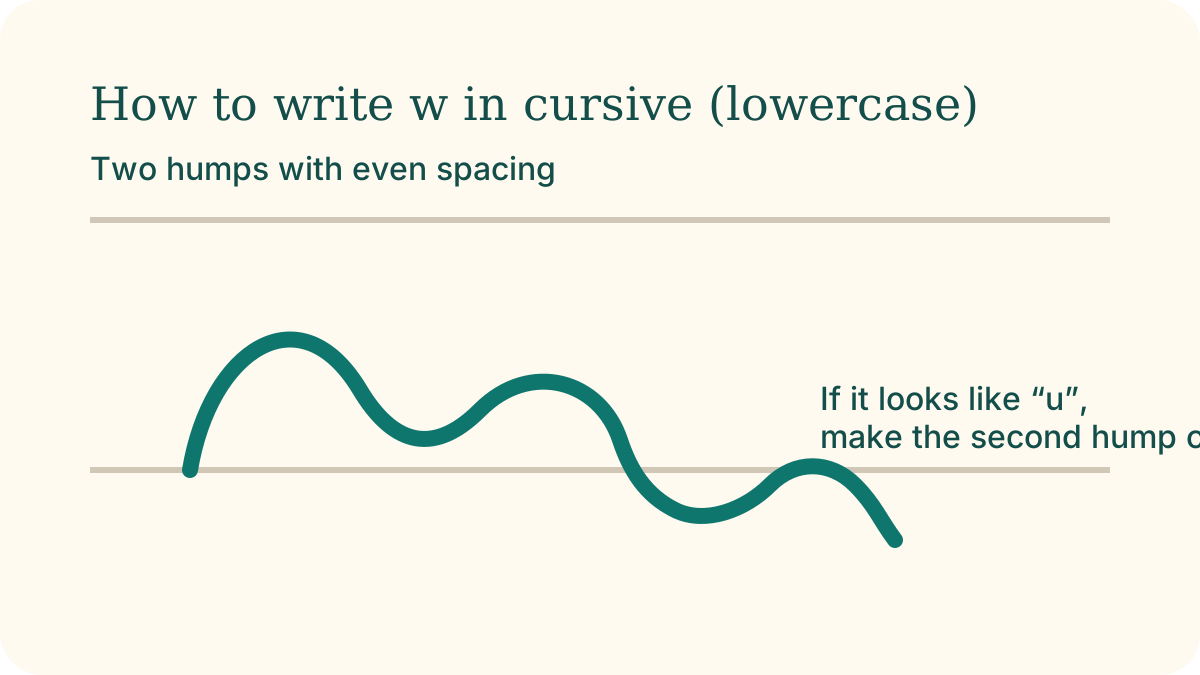
Lowercase w in cursive (step-by-step)
Think of a lowercase cursive w as two connected humps. Keep the spacing even so it does not look like u or m.
1. Entry stroke
Start on the baseline with a light entry stroke that rises to the midline. This gives you a clean lead-in from the previous letter.
2. First downstroke + hump
Curve down to the baseline, then back up to the midline to form the first hump. Avoid sharp corners.
3. Second downstroke + hump
Repeat: down to the baseline, then up to the midline for the second hump. Keep both humps similar width.
4. Exit stroke
Finish with a clear exit stroke that lifts slightly toward the next letter. This is where many w forms become hard to read.
Capital W in cursive (two common options)
There is more variation in capital cursive letters than lowercase. Choose a capital W that stays readable at your normal writing speed and matches your slant.
Option A: rounded double-hump
Make a tall downstroke, curve up and over into a rounded hump, then repeat the downstroke and hump once more. End with an exit stroke that can connect to the next letter.
Option B: looped lead-in
Add a small loop at the top of the first stroke, then flow into two rounded humps. Keep loops controlled so the letter does not look like an extra l or e.
How to connect w in cursive
Connection problems usually come from a flat exit stroke or uneven hump spacing. Practice short pairs before full words.
Easy connections
Try wi, we, wo. Keep the exit stroke pointed toward the next letter's entry.
Trickier connections
Try wr and ws. Slow down slightly so the final hump stays distinct and the next letter does not crash into it.
Word practice
Try short words like we, will, wow, and new. Circle the join that looks least clear and repeat that join three times.
Practice words for cursive w
If you are learning cursive W, practice it inside real words. A single w can look great, then fall apart when it has to connect to the next letter.
Short and easy
we, wow, new
Common joins
will, wind, write
Tricky endings
snow, show, yellow
Pick one word, write it five times, then circle the one w you would want on a birthday card. Copy that exact w shape for the next five.
A simple 5-minute W practice plan
Use this as a repeatable routine rather than a fixed timeline. Consistency matters more than long sessions.
Minute 1
Warm up with two humps: uuuu, then wwww. Keep the rhythm even.
Minutes 2-3
Write lowercase w in sets of five. After each set, check if both humps match in width and height.
Minute 4
Practice joins: wi, we, wo, wr.
Minute 5
Write one short word line: we will wow. Keep the w readable before adding style.
Common mistakes (and quick fixes)
It looks like u
Make the second hump clear and keep the exit stroke longer. A w needs two distinct humps.
It looks like m
Reduce the width slightly and keep the humps even. An m often looks wider and has three humps.
The joins look messy
Slow down at the final hump and keep the exit stroke aimed upward into the next letter.
One simple outside reference
If you want a quick definition of what cursive means, this is a safe starting point.
Reference
Cursive (Wikipedia) — a basic overview of cursive writing and how it differs from print.
FAQ
What does a cursive w look like?
A cursive w is typically built from two connected humps (similar to m or n), with an entry stroke on the left and an exit stroke on the right. The exact shape can vary by handwriting style.
How do you write a capital W in cursive?
Most cursive capital W styles use two large downstrokes connected by rounded humps or loops. Pick one style and repeat it so your capitals look consistent across words.
How do you connect w to the next letter in cursive?
Finish with a clear exit stroke that points toward the next letter's entry. If your w turns into a flat line at the end, the next letter will look disconnected or crowded.
Is there one correct cursive W?
No. Cursive letterforms vary by handwriting tradition, font influence, and personal style. The goal is a version you can write consistently and read easily.