Cursive practice
How to Learn Cursive
Learning cursive is easier when you practice in small steps: strokes, lowercase letters, joins, short words, then short phrases. This plan helps you start without guessing what to do next.
Quick visual
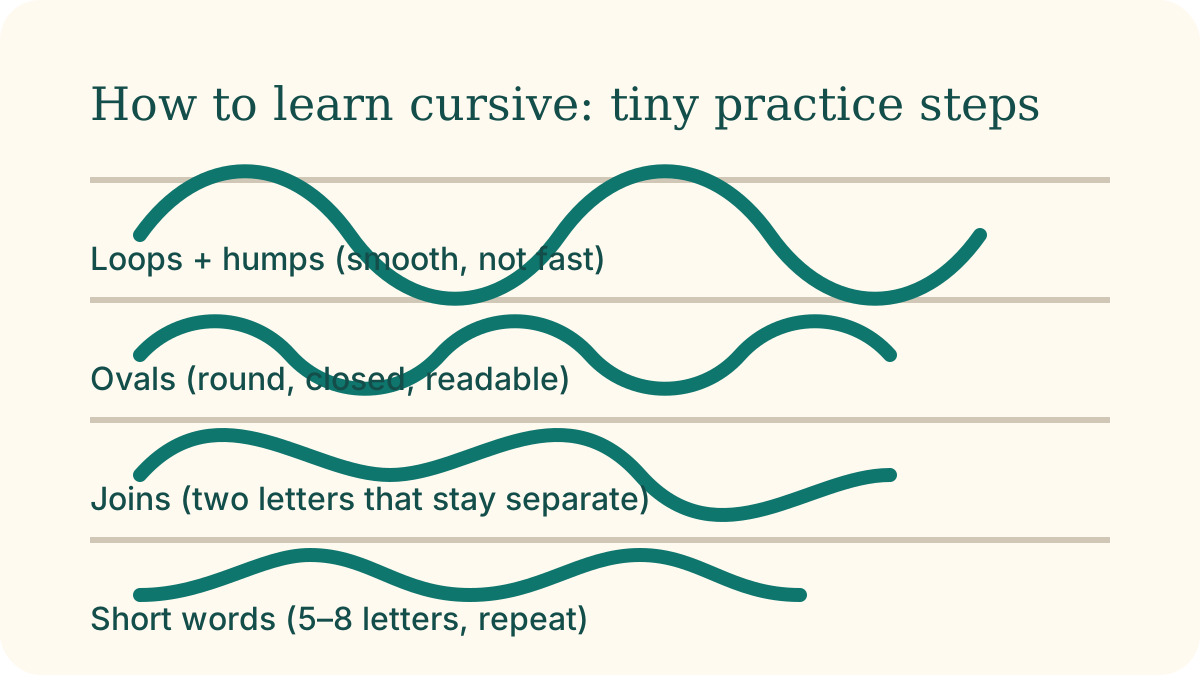
Start with the basic cursive movements
Before trying to write full sentences, practice the movements that appear inside many cursive letters. This makes the letters feel less random and helps your hand build consistent rhythm.
Loops
Loops appear in letters such as l, h, b, and k. Keep them tall enough to read, but not so narrow that they collapse into straight lines.
Ovals
Ovals appear in a, d, g, o, and q. Practice keeping the body rounded and closed enough that the letter is recognizable.
Humps
Humps appear in m, n, u, and w. Keep the spacing even so the letters do not blur together.
Descenders
Descenders appear in g, j, p, q, y, and z. Give them room below the baseline so they do not crowd the next line.
Entry strokes
Entry strokes help a letter connect from the previous one. Practice them lightly first, then connect them to real letters.
Exit strokes
Exit strokes prepare the next letter. If the exit is too short, the word may look broken; if it is too long, the word may look stretched.
Learn lowercase letters before full words
For most beginners, lowercase cursive letters are the best place to start because they appear more often inside words and rely heavily on connections. You do not need to master every uppercase letter before writing simple words.
Practice joins before long sentences
Many cursive problems happen between letters, not inside single letters. Practice short joins before writing full words. Good starter joins include la, le, he, mi, de, and oo.
Tall-to-small joins
Try l-a, h-e, and b-e. Watch the exit stroke after the tall letter.
Round joins
Try a-d, o-n, and c-e. Keep the round body clear before moving into the next letter.
Hump joins
Try m-a, n-e, and u-r. Keep each hump distinct enough to read.
Use names and short words first
Short, familiar text is easier to judge than a long paragraph. Start with your name, a short phrase, or simple practice words. If a word is hard to read, slow down and check the joins rather than adding more decoration.
A quick reality check (so you do not quit)
Your first page will look messy
That is normal. Cursive is a rhythm skill, not a one-day trick.
Slow is faster
If you go fast, your joins blur together. Go slow enough that you can see what went wrong.
A simple 10-minute daily practice plan
This is not a guaranteed timeline. Use it as a repeatable routine, and adjust the speed based on what stays readable.
Minutes 1-2
Warm up with loops, ovals, and humps. Keep the movement smooth instead of fast.
Minutes 3-5
Practice three lowercase letters from the same movement group, such as l, h, and b.
Minutes 6-8
Practice five short joins or words that use those letters.
Minutes 9-10
Write one short phrase, then circle the joins that need improvement tomorrow.
Easy practice words (so you are not guessing)
When people ask how to learn cursive, the hard part is often the connection between letters. These short words give you lots of joins without being overwhelming.
Hump rhythm
minimum, music, number, nurse
Oval control
alone, today, good, quiet
Common joins
in, on, and, time, line
When to use a cursive generator or worksheet
A cursive generator should not replace handwriting practice, but it can give you quick visual references. Use Make Cursive to preview a word, compare styles, or create a worksheet.
One simple outside reference
If you want a quick definition of what cursive means, this is a simple starting point.
Reference
Cursive (Wikipedia) — a basic overview of cursive writing and how it differs from print.
Common beginner mistakes
Practicing too much at once
It is better to practice a few letters well than to rush through the entire alphabet in one session.
Skipping joins
Single letters may look fine, but words can fall apart if the joins are unclear.
Adding decoration too early
Flourishes are easier after your basic letter shapes are readable.
FAQ
How long does it take to learn cursive?
There is no fixed timeline. Progress depends on your practice frequency, your current handwriting, and your goal. A short daily routine is usually more useful than occasional long sessions.
Should I learn uppercase or lowercase cursive first?
Lowercase letters are usually a practical starting point because they appear more often inside words and teach common joins. Add uppercase letters once you can write simple lowercase words.
Can adults learn cursive?
Yes. Adults can learn cursive by practicing the same basics: movement groups, letter shapes, joins, and short words. The main requirement is consistent practice.
Is cursive still useful?
Cursive can still be useful for signatures, handwriting practice, personal notes, decorative lettering, and reading older handwritten material. Its importance depends on your personal or educational goals.