Cursive E
Watch capital E and lowercase e together. Select a step to replay it.
Begin at the upper-right tip. Sweep left around the smaller top curve and come back to the middle.
From the middle, sweep left into the wider curve. Round the baseline and turn up to the right.
Begin low on the left and rise into the loop. Turn at the top, descend around the loop, and exit along the baseline.
Practice cursive E
E is the most common letter in English, so the size of one small loop decides how readable a whole page of cursive is. Capital E is two curves stacked around a tiny middle loop; lowercase e is a short loop that stops at the midline.
- Two stacked curves for capital E
- Loop no taller than the midline
- E / e / Ee focus modes
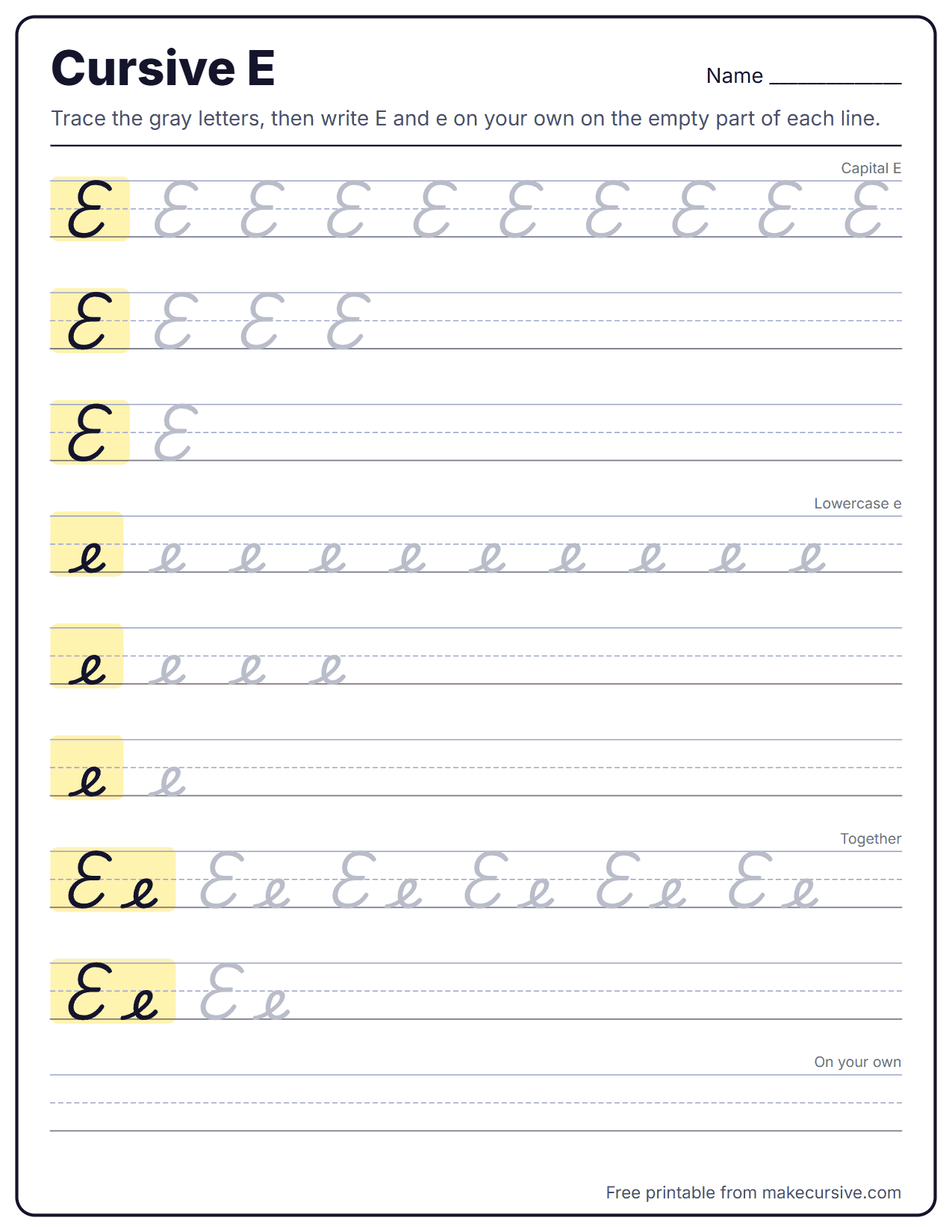
Uppercase, lowercase, and pair examples
Compare the capital E, lowercase e, and the Ee pair before you print or export practice text.
Capital E in cursive
Cursive capital E resembles a backward 3 with a lead-in: a small hook at the top, an upper curve, a tiny loop turning inward at the middle, and a wider lower curve that sweeps into the next letter. Most American school models join it.
Building capital E
- Start just below the top line with a small hook, the same opening as capital C.
- Make a short downcurve to the middle of the letter.
- Turn in toward the center, form a small loop, and swing back out.
- Make a second, larger downcurve to the baseline.
- Finish with an undercurve that joins the next letter, as in Emma.
Capital E vs C and 3
Leave out the middle loop and you have C. Bulge the curves to the right instead of the left and readers see the number 3. Size matters too: the lower curve should be wider than the upper one, because two equal curves look unsteady and more like a numeral.
Common capital E slips
- A middle loop so large the letter looks like two stacked circles.
- Starting from the bottom, which turns the loop the wrong way.
- Switching to a print E with crossbars in joined writing.
Lowercase e in cursive
Lowercase e is the smallest loop in the alphabet and lives entirely in the x-height. The hard part is keeping it that size: let it grow and e becomes l; squash it and e becomes i.
Family and height
e is an undercurve loop letter, a short version of the movement used for l. The top of the loop touches the midline and goes no higher. It enters from the baseline and exits there too, which makes it easy to join after most letters.
Lowercase e steps
- Undercurve from the baseline toward the midline at a gentle slant.
- At the midline, loop back to the left.
- Curve down to the baseline, crossing the upstroke to close the loop.
- Undercurve out to the right.
e vs l, i, and c
Height separates e from l: the e loop stops at the midline, the l loop climbs to the top line. The loop separates e from i, which is a retraced point with a dot. Direction separates e from c, which starts at the top with a hook and curves left.
Lowercase e mistakes
- A loop pinched shut, so e looks like an undotted i.
- A loop taller than nearby a and o, which makes see read as sll.
- An oversized round loop that looks like o.
A4 cursive alphabet practice sheet
Spot Ee on the A4 sheet first: the lowercase loop should be no taller than the a and o on the same rows. Then run three brief sessions aimed at loop size.
Session A: loop size
Trace a line of e, then write el el el. Short loop beside tall loop is the fastest way to calibrate height.
Session B: bridge pairs
Print be, oe, ve, and we, the joins where e has to start from the midline.
Session C: words
Write see, tree, eleven, and every. At arm's length, no e should be mistakable for l or i.
Cursive Alphabet Practice
Joining e to other letters
Because e starts from the baseline, it joins easily after a, n, or t. It gets harder after the bridge letters b, o, v, and w, and wherever several loops sit side by side.
be, oe, ve, we
The bridge arrives at the midline, already level with the top of the e loop. Dip down a little first, then loop back up. Skipping the dip leaves a flat, closed shape that looks like a dotless i.
ee in see, tree, and keep
Two loops of equal size with a visible connector. If the second loop grows, see turns into sel.
el and le in help and table
A short loop next to a tall one makes height errors obvious, so these words double as a quick test.
ea in read and ready
e exits at the baseline, but a starts at the top of its oval, so the connector has to rise and curve over first.
Capital E into lowercase
In Emma and Ethan, the capital's lower curve runs straight into the first hump of m or the tall upstroke of t without a pen lift.
Practice words for E
Names and short words that place e after bridges, beside l, and in pairs.
For whole-alphabet tracing, use the cursive alphabet worksheets.
How other handwriting models draw E
Capital E differs more between models than the lowercase: some draw a larger middle loop, and some modern styles use a simplified print-like E. In copyable text, the script E and e (ℰ and ℯ) come from the older Letterlike Symbols block, so in some fonts they look slightly different from the letters around them.
Cursive E questions
Does cursive capital E connect to the next letter?
Yes, in most American school models the lower curve ends in an undercurve that joins the following letter.
Why does my lowercase e look like l?
The loop is rising past the midline. Compare it with the a and o on the same line; the e loop should match their height.
How do I join e after o or w?
From the midline bridge, dip slightly before looping up. That small dip gives the e room to open.
Is cursive capital E just a big lowercase e?
No. Capital E is built from two curves around a middle loop; enlarging lowercase e gives an oversized loop that reads as a large l.