Cursive Q
Watch capital Q and lowercase q together. Select a step to replay it.
Begin low on the left. Sweep up over the top, around the right edge, and back into the lower turn.
Round the small loop at the foot, cross the bottom of the oval, and curl the tail up to the right.
From the upper right, sweep left around the oval and come back up the slanted side.
Follow the right slant below the baseline. Round the lower loop and rise into the high exit.
Practice cursive Q
Capital Q in school cursive looks more like the number 2 than a printed Q, and lowercase q is almost always followed by u. Learn both forms, the qu join, and how to keep q from turning into g.
- Capital Q: 2 shape with a baseline loop
- Lowercase q: forward loop below the line
- Key join: qu in nearly every word
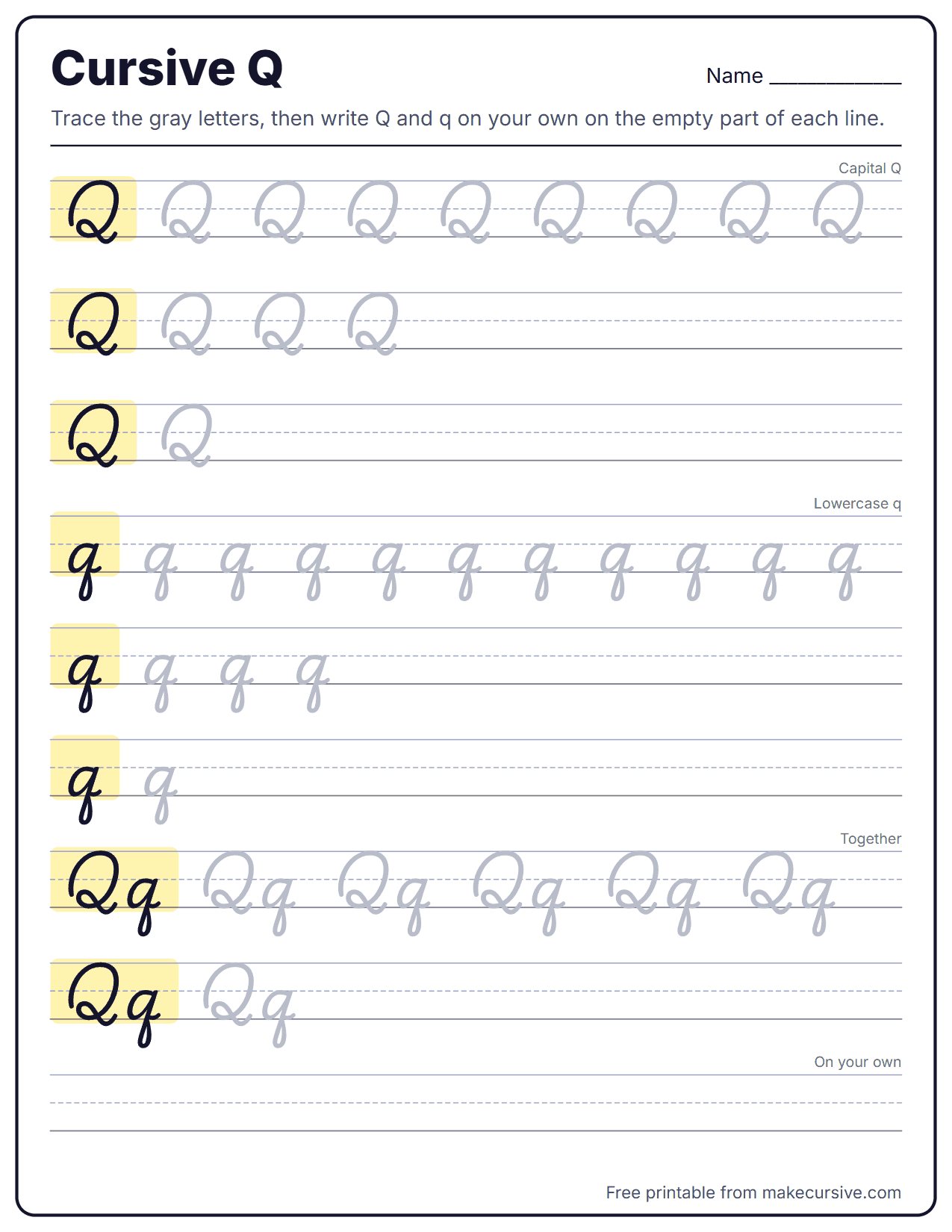
Uppercase, lowercase, and pair examples
Compare the capital Q, lowercase q, and the Qq pair before you print or export practice text.
Capital Q in cursive
The capital Q in most American school charts has no closed oval. It rolls over the top, drops diagonally to the baseline, ties a small loop, and trails off to the right, which is why learners often read it as the number 2.
Capital Q stroke steps
- Begin a little below the top line on the left with a short upward lead-in.
- Roll over the top to the right, like the head of a 2.
- Sweep diagonally down and left to the baseline.
- Tie a small loop on the baseline over the end of the downstroke.
- Finish with a short wave to the right; in many charts the u then starts on its own.
Capital Q vs the number 2
Both share the rolling top and the diagonal. A handwritten 2 ends with a flat base; the cursive Q closes a loop on the baseline and leaves with a wave. Outside words, as in a serial number, an oval Q with a crossing tail is clearer.
Common capital Q mistakes
- A flat bottom, which turns Q into 2.
- A top so closed it reads as O or C.
- A baseline loop bigger than the top curve.
- Writing Q smaller than the other capitals.
Lowercase q in cursive
Lowercase q is a downcurve letter, like a, c, d, g, and o. The oval fills the space up to the midline, and the stem drops below the baseline. Its bottom loop turns forward, which is the one detail that separates it from g.
Lowercase q stroke steps
- Overcurve up to the midline and turn back to the left.
- Curve around to the baseline and back up, closing the oval as for a.
- Pull a straight slant down through the baseline.
- Turn forward at the bottom and climb back to meet the stem at the baseline.
- Leave with an undercurve, ready for u.
q vs g, y, and a
g curls its loop to the left. y starts with a pointed undercurve, so its top is open. A q whose stem stops at the baseline is simply an a. When a q looks wrong, check the loop direction first and the stem length second.
Common lowercase q mistakes
- An open oval, which reads as u with a tail.
- A loop curled left out of habit from g.
- A wide, round loop instead of a slim one.
Joining q to other letters
The connector into q must rise and curve over the top before the oval starts. The exit is easy: the loop ends on the baseline, and the next letter is almost always u.
- qu (quiet, quick): run the exit straight into the first point of u and keep both points sharp, or the pair reads as qn.
- equ (equal): e exits low, so travel up and over; cutting across leaves a q with no top.
- squ (square): close the s first, then swing up into the q without merging the two curves.
- aqu (aqua): a and q share a body; leave a small gap and drop only the second oval.
- ique (unique): several small points follow the q, so keep spacing even to the end.
A4 cursive alphabet practice sheet
Check Qq against the full Aa-Zz alphabet on this A4 preview, then print a focused sheet for the 2-shaped capital, the forward loop, and qu words.
Trace capital Q
Fill a row with Q and write a 2 at the end to compare the bottoms.
Trace lowercase q
Pause at each descender and turn the loop right on purpose.
Qq and qu
Print Qq pairs beside qu, que, and qui.
Word lines
Finish with quiet, equal, square, and Quinn.
Cursive Alphabet Practice
Practice plan for Q
Q appears in few words, so keep sessions short.
- Shape. Open focus practice, show Q, and write a row of capitals with a quick 2 after every third one. Then switch to q and say "forward" each time the descender turns.
- Pairs. Make a worksheet of qu, que, qui, and quo with a few gu pairs mixed in, so you change loop direction deliberately.
- Words. Trace quiet, equal, square, and unique, then write "The quick queen asked a quiet question." from memory and circle any loop that turned the wrong way.
Practice words for Q
Each word puts q after a different letter or at the start of a name.
q almost never ends an English word. For the rest of A-Z, print the cursive alphabet worksheets.
Cursive Q questions
Why does cursive capital Q look like a 2?
The 2-like Q comes from older American copybook styles, and school models kept it because it can be written in one continuous stroke. The loop on the baseline and the u that almost always follows tell a reader it is a Q, not a number.
Can I write an oval Q in cursive instead?
Yes. Many adults use an oval Q with a short tail crossing the bottom, close to the printed letter. It is fully readable and safer on forms or anywhere a digit could appear. Pick one and use it consistently.
How is lowercase q different from g in cursive?
Both have a closed oval and a descender. The q loop turns forward, to the right, and closes at the baseline; the g loop swings back to the left and crosses the stem. Check only the direction of the bottom turn.
Does capital Q connect to the u that follows?
It depends on the chart. In many American school models the Q tail stops on the baseline and the u starts with its own short upstroke right beside it. Other models run the tail into the u. Both read correctly.
How other handwriting models draw Q
Charts disagree about capital Q more than most letters, so treat these steps as one common American school version. Several handwriting fonts draw an oval Q instead, so a generator preview may not match your chart.