Cursive I
Watch capital I and lowercase i together. Select a step to replay it.
Begin at the short inward hook on the left. Swing along the baseline, rise around the tall loop, and come down through the crossing.
Pull the short slant down from the midline. Turn at the baseline and carry the exit up to the right.
Lift the pen and place the dot above the short stem.
Practice cursive I
Cursive I looks easy, but each form has a trap. Capital I is often read as capital J, and lowercase i becomes e as soon as its point turns into a loop. The dot has its own timing too: it goes on after the word.
- Lowercase i: a sharp point, never a loop
- Dot after the whole word
- Capital I ends on the baseline; J goes below
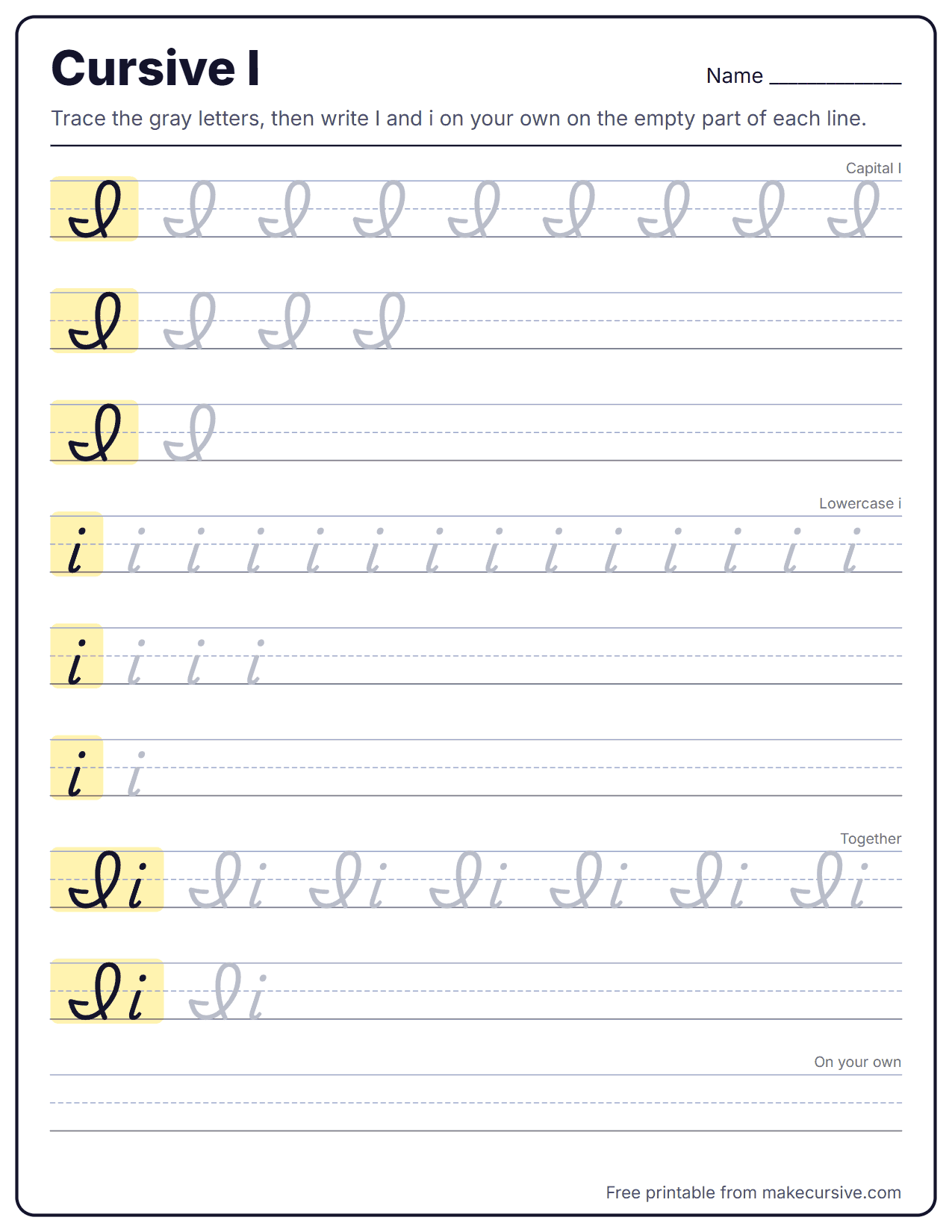
Uppercase, lowercase, and pair examples
The capital is one tall sweeping stroke; the lowercase is one short stroke plus a dot.
Capital I in cursive
School-cursive capital I looks nothing like the printed I with bars. It is one sweeping stroke that starts low, rises to the top line, and returns with a curl at the baseline. In English it is mostly written alone, as the word I, so its spacing matters more than its join.
Capital I stroke steps
- Start a little above the baseline, to the left of where the letter will stand.
- Overcurve up and to the right until you reach the top line.
- Curve down along the slant to the baseline.
- Curl a little to the left and up, then retrace a short way.
- Finish with a small curve to the right. Many charts leave this unjoined.
Capital I vs capital J
I and J begin with the same overcurve and come down on the same slant. Capital I stops at the baseline with a small curl. Capital J passes through the baseline, loops back to the left below it, and joins the next letter. If your I dips under the line, Ivy starts to read as Jvy.
Common capital I mistakes
- Adding printed top and bottom bars.
- A down stroke that falls straight instead of slanting.
- A bottom curl so big it reads as a loop.
- Crowding the word I against the next word.
Lowercase i in cursive
Lowercase i is the basic undercurve letter that u, w, and t are built from. It stays inside the x-height zone; only the dot sits above the midline.
Lowercase i stroke steps
- Undercurve from the baseline to the midline.
- Stop at a sharp point and slant straight back down the same path.
- Undercurve out toward the midline.
- Write the rest of the word.
- Return and place a small dot above the stem, about halfway to the top line.
i vs e, u, t, and j
e is the same height but opens into a loop at the top, which is why a loose retrace turns time into teme. u is two i shapes without the dot. t is taller and crossed. j has the same start as i but continues below the baseline.
Common lowercase i mistakes
- A rounded tip that opens into an e loop.
- Forgetting the dot, or placing it over the next letter.
- Stopping mid-word to dot, which breaks the rhythm.
- An entry stroke that rises above the midline.
Joining i to other letters
i enters and exits low, so its joins are short. Problems appear after bridge letters, before oval letters, and in long runs of similar strokes.
oi, wi, vi (coin, win, visit)
These letters end with a bridge at the midline. The bridge becomes the top of the i, so go straight down from it. Adding a small upstroke creates a loop, and coin reads as coen.
ie, ei (piece, receive)
A point and a loop side by side. Keep the i sharp and the e open so readers can tell the order.
io, ia (radio, piano)
Rise to the midline, then curve back over to the left to start the oval.
imi, ini (minimum, mini)
Rows of short down strokes blur together. Keep every point the same height and space the dots evenly.
For a worked example of the two-letter word in, see writing "in" without making "m".
A4 cursive alphabet practice sheet
The A4 preview shows Ii in context. Lowercase i is quick to learn, so the routine spends most of its time on contrast and dotting.
Step 1: point vs loop
With the form above, print a line of i e i e. Every i should end in a point.
Step 2: dot timing
Write coin, piece, and visit without lifting, then go back and dot every i in one pass.
Step 3: capitals
Write I think Iris is in Italy, keeping a clear space after the word I. Check it in focus practice on the I view.
Cursive Alphabet Practice
Practice words for I
Pick words where i sits next to e, after a bridge letter, or in a run of short strokes. Those are the places it stops being readable.
Minimum is the hardest word here: the i and u strokes need sharp points while m and n stay rounded, so check each top before dotting. For the rest of A-Z, print the cursive alphabet worksheets.
Cursive I questions
When do you dot the i in cursive?
After the whole word is written. Finish the word in one movement, then go back and dot each i and cross each t. This keeps the joins smooth.
Why does my cursive i look like an e?
The top is rounding into a loop. Stop at a sharp point and come straight back down the same path before the exit stroke.
What is the difference between cursive capital I and J?
They start the same way. Capital I ends at the baseline with a small curl, while capital J continues below the baseline and loops back to the left.
Does capital I connect to the next letter?
In many school charts it does not, and as the word I it stands alone anyway. In names such as Iris, start the next letter close to the curl.
How other handwriting models draw I
Older copybook styles sometimes give capital I a large top loop, which brings it even closer to J. Follow your own chart when it differs.