Cursive H
Watch capital H and lowercase h together. Select a step to replay it.
Begin with the small top hook. Turn into the slant and bring the left stem straight down to the baseline.
Lift to the upper-right tip and pull a parallel slant down to the baseline.
Sweep left into the middle loop. Round the turn and carry the cross stroke out to the right.
Rise from the baseline into the tall loop, come down the stem, and retrace just far enough to round the low hump and exit.
Practice cursive H
Cursive H is built from tall strokes. The capital is written in two parts with a looped crossbar, and lowercase h is an l-style loop followed by one n-style hump. Most trouble comes from a pinched hump or a collapsed loop.
- Capital H: two parts, joins from the second
- Lowercase h = l loop + n hump
- Common joins: th, wh, sh
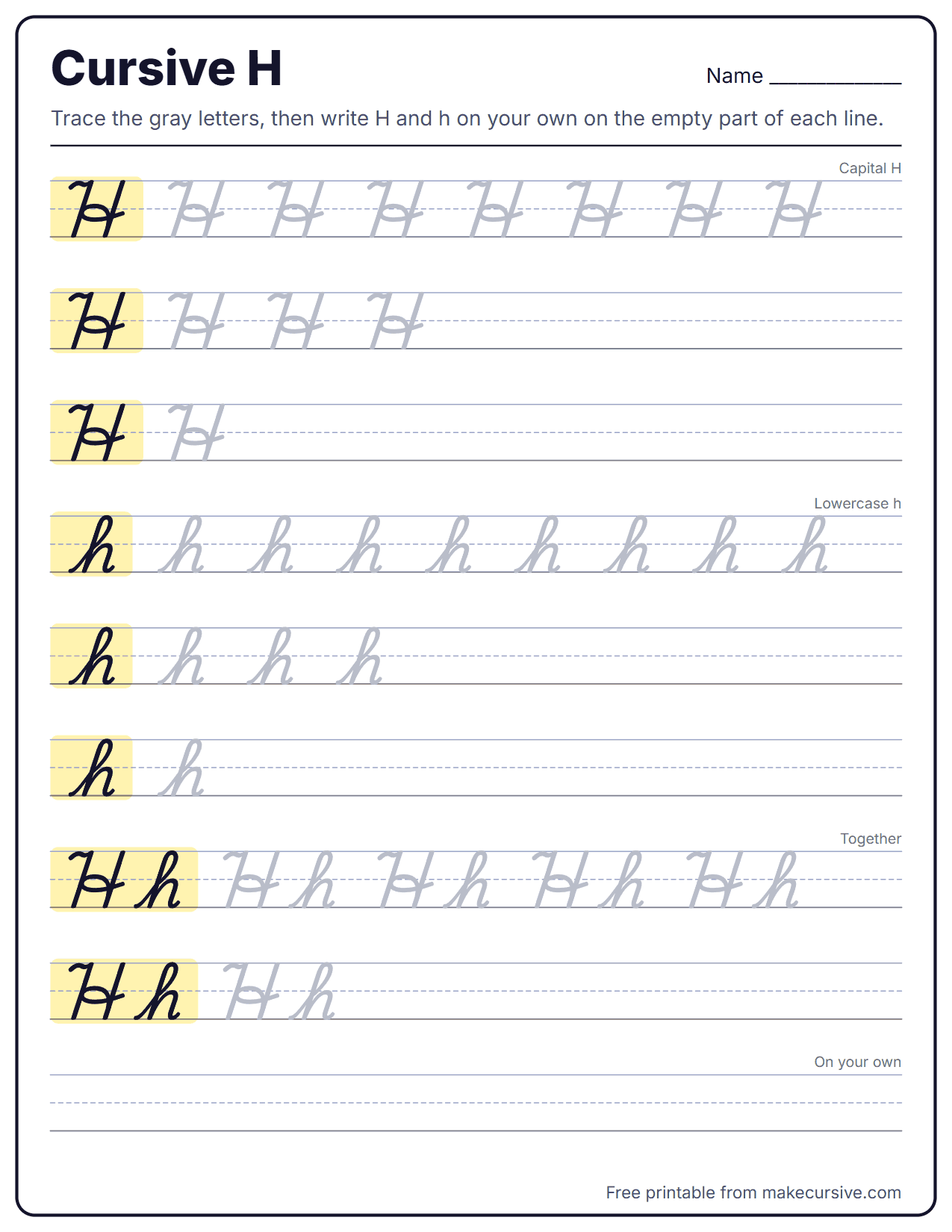
Uppercase, lowercase, and pair examples
Both forms reach the top line, but only the capital needs a pen lift.
Capital H in cursive
Capital H is written in two separate parts. The left stem stands alone; the right stem carries a small loop that replaces the printed crossbar, and its final stroke is the one that connects to the rest of the word.
Capital H stroke steps
- Start a little below the top line with a short forward curve, then slant down to the baseline. Lift.
- Move right and start again at the top line with a curve back, then slant down parallel to the first stem.
- Retrace up the second stem to about the midline.
- Make a small loop to the left, toward the first stem. This loop is the crossbar.
- Curve out to the right and into the next letter.
Capital H vs capital K
In most school models H and K open with the same left stem, so the second part decides. H has a second stem parallel to the first and a loop at the midline. K's second part comes in at an angle, touches the stem near the middle, and kicks out to the baseline. Write Henry above Kevin to check them.
Common capital H mistakes
- A second stem shorter than the first, so the letter tilts.
- A crossbar loop so high it reads as two separate letters.
- Stems leaning at different angles.
- Trying to join from the left stem, which crosses through the letter.
Lowercase h in cursive
Lowercase h is a loop letter. It shares its tall loop with l and its hump with n, so it sits in the ascender and x-height zones and never goes below the baseline.
Lowercase h stroke steps
- Undercurve from the baseline to the top line.
- Loop back to the left and slant straight down to the baseline.
- Without lifting, overcurve back up the stem to the midline.
- Slant down to the baseline to finish the hump.
- Undercurve out toward the next letter.
h vs k, n, l, and b
Take away the loop and you have n; take away the hump and you have l. k has the same loop, but its second half is a small closed tuck at the midline that kicks out, so a hump that pinches shut reads as k. b also starts with the loop but ends with a tie at the midline instead of a hump.
Common lowercase h mistakes
- A pointed or pinched hump that turns h into k.
- A loop so short the letter looks like n.
- A hump taller than the midline.
- Lifting at the baseline before the hump.
Joining h to other letters
h leaves low from the baseline, but it enters with a stroke that climbs all the way to the top line. That long climb is where most h joins go wrong.
wh (when, what, which)
w ends with a bridge at the midline, so the climb starts high and the loop tends to come out thin. Give it width.
th (the, that, with)
Keep the t clearly shorter than the h, and add the t cross after the word so the climb is not interrupted.
sh (she, wish)
s closes at the baseline. Make that closure small before rising, or it grows into an extra loop.
gh (night, laugh)
The climb starts below the line at the g crossing. Match the h loop to the slant of the g stem.
ha, ho (have, hope)
After the hump, rise to the midline and curve back over before drawing the oval.
A4 cursive alphabet practice sheet
The A4 preview shows Hh next to its neighbors. Since h is literally l plus n, the routine builds it from those parts.
Round 1: parts
Use the form above to print a sheet with l, n, and h rows. Write each row once, then compare all three.
Round 2: joins
Write th, wh, sh, ch, and gh, keeping the Hh focus view open as a model.
Round 3: sentence
Write Henry hopes the hike is short. Count the tall loops and make sure each is open.
Cursive Alphabet Practice
Practice words for H
h is one of the most frequent letters in English because of the, that, and when, so a few short words give a lot of practice.
Write which and high back to back: both have two h's, each entered from a different letter, so uneven loops show up quickly. For the full alphabet, print the cursive alphabet worksheets.
Cursive H questions
Does capital H in cursive connect to the next letter?
Usually yes, but only from the second part. The left stem stands alone, and the right stem ends with the crossbar loop and a curve that leads into the next letter, as in Hannah.
Is capital H written in one stroke?
Not in most school models. The left stem is one stroke, then you lift and write the right stem with its loop. Some decorative fonts draw H in one continuous line.
What is the difference between cursive h and k?
Both start with the same tall loop. h finishes with a rounded hump like n; k finishes with a small closed tuck at the midline and a kick out to the baseline.
Why does my lowercase h look like n?
The loop is too short. It should reach the top line, about twice the height of the hump. Practice l and h in alternating rows.
How other handwriting models draw H
Some programs start capital H with a looped or curled first stroke, and some draw lowercase k with an open kick instead of a closed tuck, which changes the h and k comparison above.