Cursive O
Watch capital O and lowercase o together. Select a step to replay it.
Go left and down around the big oval. Rise up the right edge, then curve inward and take the short high exit across.
Begin near the top of the oval. Curve left and down, round the baseline, and return to the starting point without opening a gap.
Practice cursive O
Cursive O is a closed oval with a twist: lowercase o leaves from the midline instead of the baseline, which changes how every following letter joins. Capital O closes with a small inner loop and usually stands apart.
- View O, o, or Oo at large size
- Compare with N and P using Prev and Next
- White noise for slow, even ovals
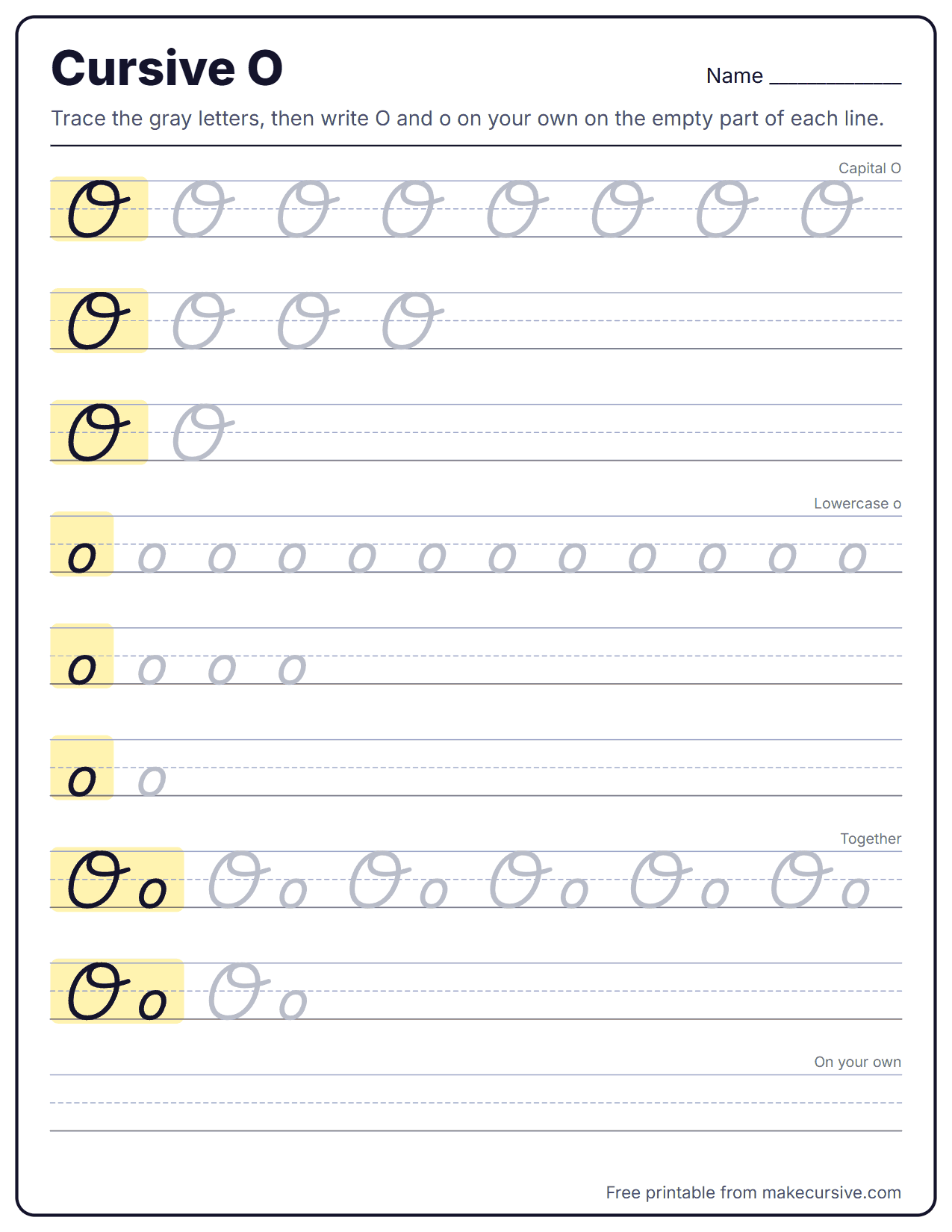
Uppercase, lowercase, and pair examples
Set capital O, lowercase o, and Oo side by side. Both ovals should be fully closed, with the lowercase exit at the midline.
Capital O in cursive
Capital O starts at the top, travels counterclockwise to close the oval, and finishes with a small loop inside the top before a short tail. In Zaner-Bloser and most American school models that tail does not join, so you lift before the next letter.
Capital O stroke steps
- Start just below the top line, slightly right of center.
- Downcurve to the left and around to the baseline.
- Curve up the right side back to the start to close the oval.
- Make a small loop inside the top.
- Finish with a short curve to the right, then lift.
Capital O vs C, D, and zero
C starts the same way but stays open. D has a big curved side too, but begins with a stem and a baseline loop. A zero has no loop or tail, so the small inner loop marks your O as a cursive capital. Cursive Q looks more like a 2, so it is rarely the problem.
Common capital O mistakes
- A gap where the oval should close, so O reads as C.
- Drawing clockwise, which puts the loop and tail on the wrong side.
- Stretching the tail to reach the next letter, pulling the O lopsided.
Lowercase o in cursive
Lowercase o belongs to the downcurve family with a, c, d, g, and q, and stays within the x-height. Like b, v, and w, it finishes with a short bridge at the midline, so the next letter starts from the top instead of the baseline.
Lowercase o stroke steps
- Arrive at the midline from the previous letter, or with a short overcurve.
- Downcurve to the left and around to the baseline.
- Curve back up the right side to close the oval.
- Add a tiny loop or retrace at the top if your model shows one.
- Leave with a small bridge stroke, level with the midline.
o vs a, e, and u
a uses the same oval but ends with a downstroke and a baseline exit, so a sagging bridge turns o into a. An oversized closing loop reads as e, and an o left open at the top looks like u. A closed oval plus a level bridge is the whole letter.
Common lowercase o mistakes
- Starting at the baseline and going clockwise, a habit from printing.
- Letting the bridge drop to the baseline.
- Losing the closed top when writing quickly.
Joining o to other letters
Every letter after o starts from the midline, so the next letter has to adapt its entry. These are the joins most worth practicing.
or in for and word
r starts straight from the bridge. Keep its small shoulder visible, or the pair reads as an undotted oi.
os in most and rose
s usually begins on the baseline. After o, start it from the bridge, make its point at the midline, then curve down.
oe in shoe and toe
From a bridge, e becomes a small loop hanging from the midline. Keep it open so shoe does not turn into shoo.
oa in boat and road
a starts at the top with its own downcurve. Carry the bridge a little right, then curve back into the a oval, or the letters blur.
A4 cursive alphabet practice sheet
Use the A4 preview to compare o with the other oval letters a, d, g, and q, then print an O worksheet that keeps the bridge level.
Ovals and bridges
Write a row of linked o letters and check that every bridge stays on the midline.
Oo spacing
Lift after capital O and place the lowercase o close enough to read as one word.
Cursive Alphabet Practice
Practice plan for O
Ovals are quick to learn but hard to keep consistent, so this plan spends most of its time on what happens after the o.
- Session 1: the oval. In focus practice, choose the lowercase view and trace o, then write a row of a, o, and d to feel the shared downcurve. Add five capital O letters, each with its inner loop.
- Session 2: bridges. Write or, os, oe, oa, and on three times each. If a pair looks like different letters, slow down on the bridge.
- Session 3: a sentence. Type Oscar rowed the old boat home into the generator, compare its joins with yours, and copy it twice without looking.
Practice words for O
Each word sends the o bridge into a different letter, plus two names that practice the lift after capital O.
When you are ready to review the whole alphabet, print the cursive alphabet worksheets.
How other handwriting models draw O
Capital O is fairly stable across models, but details change: some styles drop the inner loop, Palmer-era copybooks add a larger flourish, and many UK joined styles never join capitals anyway. In lowercase, some models close o with no loop at all. Handwriting fonts often skip the true midline bridge, so use them to choose a look rather than to learn the join.
Cursive O questions
Does cursive capital O connect to the next letter?
Usually not. In most American school models capital O ends with a small loop and a short tail that does not join, so you lift and begin the next lowercase letter separately.
Why does my lowercase o look like an a?
The exit is probably dropping to the baseline. Lowercase a ends with a downstroke and a baseline exit, while o ends with a bridge that stays at the midline.
Which direction should I write cursive o?
Counterclockwise. Start at the top, curve left and down, then come back up the right side. Going clockwise makes the bridge exit awkward.
What is a bridge stroke in cursive?
A short connecting stroke that leaves a letter at the midline instead of the baseline. Lowercase b, o, v, and w end with bridges, so the following letter starts from the top.