Cursive Y
Watch capital Y and lowercase y together. Select a step to replay it.
Begin at the short left entry. Glide into the shallow upper bowl and rise again to the far tip.
Trace down the right side and round the deep lower loop. Rise through the crossing and sweep out.
From the midline, sweep down and around the bowl. Rise back up the right side to the top of the stem.
Retrace down the tall slant and round the loop below the baseline. Sweep back up and out across the stem.
Practice cursive Y
Cursive y is a descender letter: the top sits in the x-height band and the second downstroke drops below the baseline into a loop. Capital Y uses the same loop, which is what separates it from capital U, and it joins the next letter.
- View Y, y, or Yy alone in focus mode
- Trace sheet opens with Yy filled in
- Compare y, g, and j in the generator
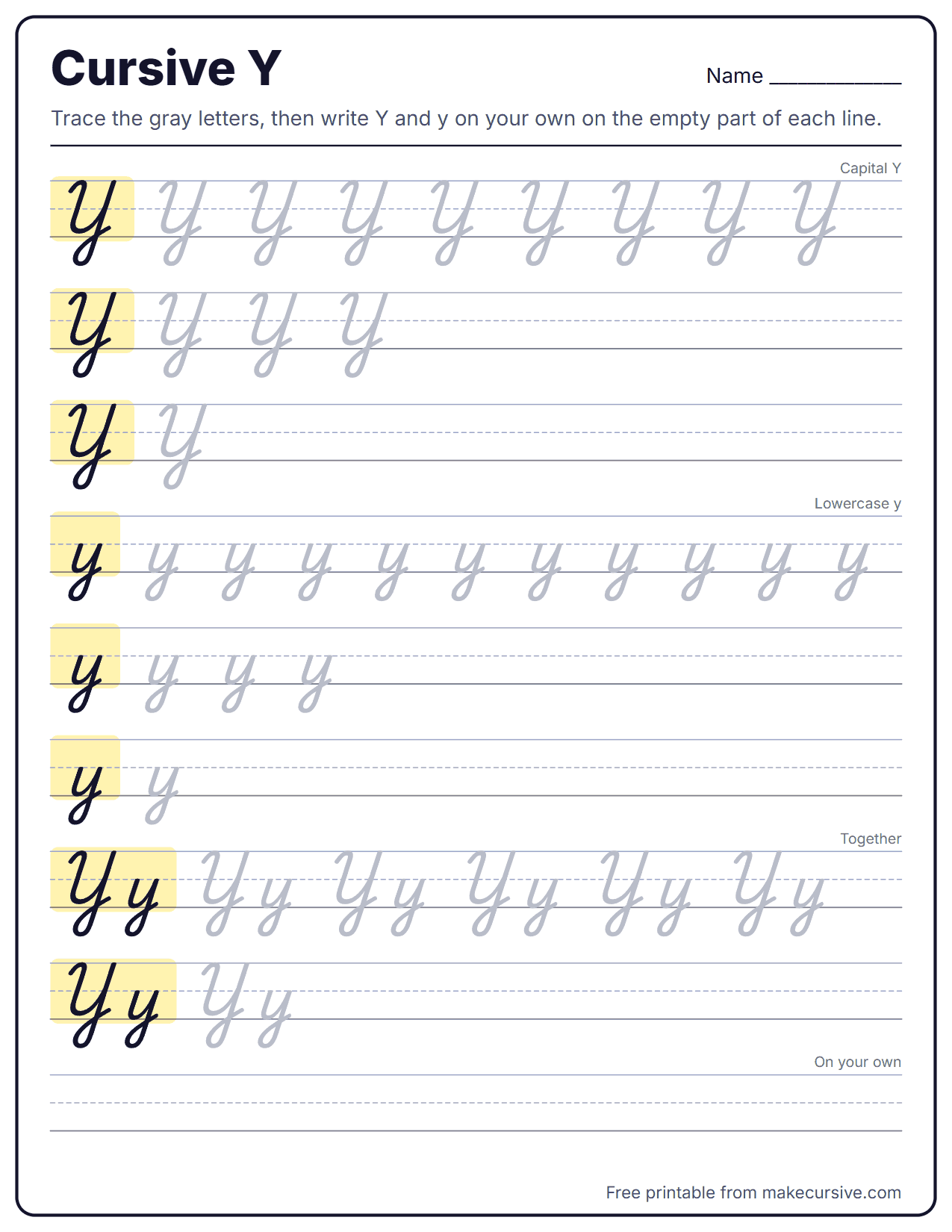
Uppercase, lowercase, and pair examples
Compare the capital Y, lowercase y, and the Yy pair before you print or export practice text.
Capital Y in cursive
Capital Y begins exactly like capital U and only reveals itself at the end, when the second downstroke keeps going below the baseline. Unlike V, W, and X, it finishes with an upswing that connects to the next letter.
Capital Y stroke steps
- Make a small cane just below the top line.
- Slant down to the baseline and round the bottom.
- Undercurve up to the top line.
- Slant straight down, through the baseline, into the descender space.
- Loop back to the left and close the loop at the baseline.
- Overcurve up and to the right into the next letter.
Capital Y vs capital U
Steps one to four are shared. On U, the second downstroke stops at the baseline and swings out; on Y, it dives below the line and returns as a loop. A shallow Y descender reads as U.
Common capital Y mistakes
- Making the loop as tall as the capital, so it hits the line below.
- Closing the loop above or below the baseline instead of at it.
- Letting the second downstroke curve, which bends the whole letter.
Lowercase y in cursive
Lowercase y shares its lower loop with g, j, and z. Get that loop right once and it carries over to all four letters.
Stroke family and height
The top fills the x-height band; the loop hangs below the baseline. Zaner-Bloser opens y with a small overcurve hump, as in n, while D'Nealian-style and many adult hands start with a u-like undercurve. Both end the same way.
Lowercase y stroke steps
- Enter at the midline (overcurve or undercurve, depending on your model).
- Slant down to the baseline and round the bottom.
- Undercurve back up to the midline.
- Slant down below the baseline and loop back to the left.
- Cross at the baseline and overcurve out.
y vs g vs j, and the "ij" problem
All three share the lower loop. The difference is the top: g has a closed oval like a, j has a single upstroke and a dot, and y has an open cup with two downstrokes. If the cup is too narrow and the two downstrokes do not meet at the bottom, y can read as an undotted "ij".
Common lowercase y mistakes
- A loop that leans backward against the slant.
- Closing the cup at the top, which turns y into g.
- A loop that never closes, which looks like a fishhook.
Joining y to other letters
The exit of y is an overcurve that starts below the line and swings up from the bottom of the loop. That long upstroke helps with some letters and gets in the way of others.
ye in yes and eyes
The upswing wants to keep climbing. Stop it at the midline and turn it into a small e loop, or the e grows into an l.
yo in you and young
Let the overcurve carry over the top and down into the o. This is one of the smoothest y joins.
oy in boy and toy
The o bridge leads into the start of y at the midline. Keep the bridge level so the cup does not start too low.
ly in only and family
The tall l and the long y loop sit side by side. Keep both loops narrow so they do not cross each other.
Final y in day and happy
At the end of a word, you can stop the exit soon after the loop crosses the baseline.
A4 cursive alphabet practice sheet
Check Yy against the other descenders on the alphabet preview, then print a sheet that puts y, g, and j on the same lines.
Loop depth
Use guide lines with a visible baseline so every loop closes in the same place.
Y beside U
Alternate the two capitals until the descender is automatic.
Cursive Alphabet Practice
Practice plan for Y
Work from the loop outward: first its size, then the letters around it, then whole lines where loops can collide.
- Loop control. In focus practice, choose lowercase y and write a row of loops only, all the same depth and all closing on the baseline. Then write full y letters and capital Y on the same line.
- Neighbours. Trace ye, yo, oy, and ly from a worksheet. Look for any e that grew too tall and any l and y loops that touch.
- Two lines at once. Write "Yara and her family say yes to you every day" on two lines in a row. Loops from the first line should never reach the tall letters of the second.
Practice words for Y
Each word places y at the start, middle, or end, or next to a letter that changes the join.
Review Yy with the rest of the alphabet using the cursive alphabet worksheets.
How other handwriting models draw Y
School programs disagree on how y starts and how deep its loop goes, so match the model your class or workbook uses. Some handwriting fonts draw y with an open tail instead of a loop.
Cursive Y questions
How is cursive y different from cursive g?
They share the same lower loop. The top of g is a closed oval, like a; the top of y is an open cup. Close the top of a y and it turns into g.
Why does cursive capital Y look like U?
Both start with the same cane, downstroke, and upstroke. Y only becomes Y when its final downstroke drops below the baseline into a loop.
Does capital Y connect to the next letter?
Yes, in most school models. The loop finishes with an overcurve that rises into the next lowercase letter, as in Yara or York.
Why does my y look like "ij"?
The two downstrokes are probably separated at the bottom. Round the base of the cup so the first downstroke curves into the second, and the pair will read as one letter.
How long should the loop on a cursive y be?
About as deep as the top half of the letter is tall. Much longer loops collide with the next line of writing; much shorter ones make y look like v.