Cursive L
Watch capital L and lowercase l together. Select a step to replay it.
Start at the small left entry. Sweep around the upper loop, bring the stem down, and turn through the baseline curl before exiting.
Sweep up from the baseline, round the loop, then pull down to the baseline and turn the short exit up.
Practice cursive L
Cursive L is all about loops. Capital L opens with a loop at the top and finishes with a small loop on the baseline; lowercase l is a single tall loop that has to stay open and upright.
- View L, l, or Ll at large size
- Step to K or M to compare tall strokes
- Optional white noise while tracing loops
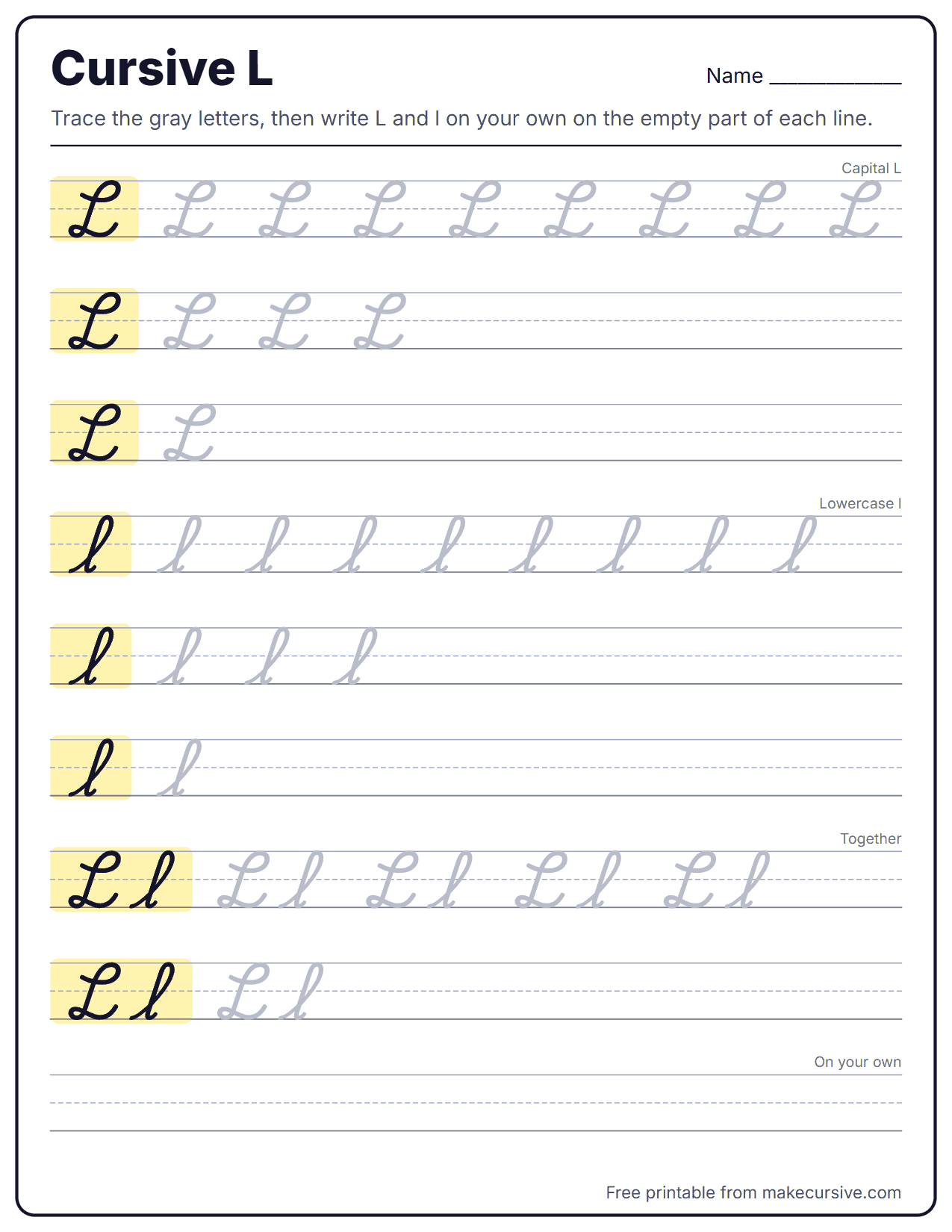
Uppercase, lowercase, and pair examples
Look at capital L, a single lowercase l, and the Ll pair together. The lowercase loop should rise nearly as high as the capital.
Capital L in cursive
Capital L in school cursive has almost no straight lines. It begins with a loop near the top line, sweeps down, and makes a second, smaller loop on the baseline before running out to the right. Because that baseline loop is what people remember, a careless L is read as S or D.
Capital L stroke steps
- Start a little below the top line and undercurve up to it.
- Loop back to the left so the stroke crosses itself.
- Curve gently down to the baseline at your normal slant.
- Make a small loop that lies almost flat on the baseline.
- Curve out to the right; in most American models this joins the next letter.
Capital L vs S and D
All three end low with a curl. S starts on the baseline and its lower curve closes back on the left. L starts high with a top loop, and its baseline loop sends the stroke away to the right. D loops on the baseline too, then climbs the right side to close a big bowl.
Common capital L mistakes
- Skipping the top loop and starting with a straight downstroke.
- A baseline loop so large it looks like a second letter.
- An exit that stays high, so the next letter starts in the air.
Lowercase l in cursive
Lowercase l is the simplest loop letter: an undercurve to the top line, a loop, a straight slant down, and an undercurve out. It is the same motion as cursive e, stretched from the midline up to the top line.
Lowercase l stroke steps
- Start on the baseline and undercurve up to the top line.
- Loop back to the left, keeping the loop narrow but open.
- Slant straight down to the baseline, crossing the upstroke near the midline.
- Undercurve out to the right.
l vs e, t, and i
Shrink an l to the midline and you get e, the most common l mix-up, as in feel and belt. t reaches the same tall zone but is retraced and crossed, not looped. i is short and dotted. A fully closed l loop passes for an uncrossed t.
Common lowercase l mistakes
- A loop so wide that the double l in hello looks like two e letters.
- A loop that stops short of the top line.
- Two l's in ball or will leaning at different angles.
Joining l to other letters
Lowercase l starts and ends on the baseline, so it connects easily from most letters. Problems come from midline exits and from l's in clusters.
ll in hello and ball
Keep both loops parallel and equally tall, with a small gap at the baseline so they do not merge into one thick stroke.
ol and wl in old and owl
o and w end with a bridge at the midline. From the bridge, keep climbing to the top line rather than dipping first.
lt in salt and belt
l is looped and t is not. Loop the t as well and belt turns into bell.
ly in only and family
The l exit becomes the overcurve of y, which drops below the baseline. Keep the y tail clear of tall loops on the next line.
A4 cursive alphabet practice sheet
Use the A4 preview to compare l with the other tall loops in the alphabet, then print an L worksheet that trains loop height before speed.
Tall loop ladder
Write e l e l across a row until the size difference is automatic.
Double l words
hello, ball, and yellow show whether paired loops stay parallel.
Cursive Alphabet Practice
Practice plan for L
Loops get sloppy when written fast, so this routine adds speed only after height and slant are steady.
- Day 1: loop height. On the printed guide lines, write a row of l, a row of e, then a row alternating them. Stop when every l touches the top line. Write capital L five times, saying loop, down, loop, out.
- Day 2: clusters. Practice ll, ol, le, and lt. Write belt next to bell and check that only the l is looped.
- Day 3: real text. Type Lily will fill the yellow bowl into the generator, then write it yourself twice. Lay a ruler along your l downstrokes to check the slant.
Practice words for L
These words test the capital loop, single and double l, and the joins on both sides of the letter.
Keep a printed reference of every letter with the cursive alphabet worksheets.
How other handwriting models draw L
L varies more at the capital than in lowercase. Older copybook and Palmer capitals often use a bigger, decorative top loop, and some UK joined styles write lowercase l as a plain stick with an exit tail.
Cursive L questions
Why does my cursive l look like an e?
The loop is too short. Lowercase l must reach the top line, while e stops at the midline. Alternating e and l across a line helps you feel the difference.
Does cursive capital L connect to the next letter?
In most American school models, yes. The small baseline loop is followed by an undercurve that leads into the next lowercase letter, as in Lucy or Laura.
Why does my capital L look like an S?
Usually the top loop is missing or the bottom curl turns inward. Capital L starts high with a loop and its baseline loop opens to the right; S starts on the baseline.
Is lowercase l in cursive always looped?
In Zaner-Bloser, D'Nealian, and Palmer cursive it is. Some UK and European joined styles use an unlooped l with a curved exit. Pick one form and use it consistently.