Cursive K
Watch capital K and lowercase k together. Select a step to replay it.
Sweep through the top hook, turn at the shoulder, and pull the left stem to the baseline.
Start at the upper-right tip and curve down toward the stem. Turn back out at the middle and sweep through the lower leg.
Rise from the starting stroke into the tall loop and trace the slanted stem all the way back to the baseline.
Return to the middle of the stem. Curve into the small loop, then round the lower leg and exit to the right.
Practice cursive K
Cursive K is built from a tall stem and a second stroke that tucks in near the middle before kicking out. Lowercase k adds a small closed buckle, which is the only thing keeping it from turning into h.
- Switch between K, k, and Kk to study the buckle
- Step back to J or ahead to L with Prev and Next
- Optional white noise for slow tracing
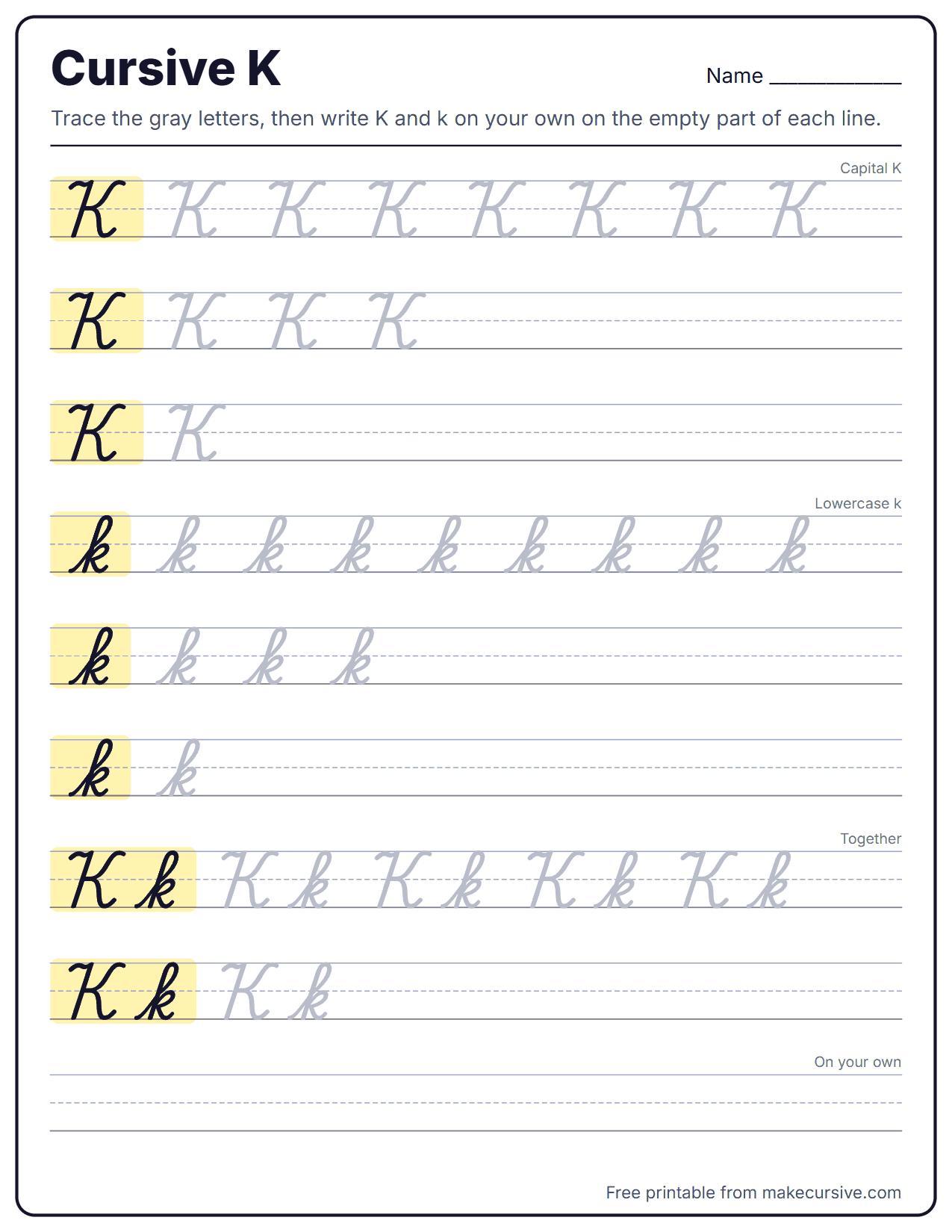
Uppercase, lowercase, and pair examples
See capital K, lowercase k, and the Kk pair side by side. The lowercase buckle is easiest to judge at this large size.
Capital K in cursive
Capital K is usually written with a pen lift. The first stroke is a tall stem; the second starts at the top right, tucks in to meet the stem near the midline, then kicks down to the baseline. That kick is what separates it from capital H.
Capital K stroke steps
- Start just below the top line with a small overcurve and slant the stem down to the baseline. Lift.
- Place the pen on the top line, right of the stem, and curve down and to the left.
- Near the midline, tuck in to touch the stem. Many models add a tiny loop here.
- Kick down and to the right to the baseline, ending in an undercurve.
- Zaner-Bloser-style models join that undercurve to the next letter; others lift.
Capital K vs capital H
Both begin with a similar stem and a pen lift. H then builds a second upright stem tied to the first by a crossing loop, so it has two parallel downstrokes. K has one downstroke and a bent arm that leaves at an angle. If the arm comes down too vertically, Kim starts to look like Him.
Common capital K mistakes
- A wide gap between arm and stem, so the letter falls into two pieces.
- Tucking in near the top line, which makes the kick far too long.
- Forcing a join when the kick ends above the baseline; lift instead.
Lowercase k in cursive
Lowercase k belongs to the loop family with l, h, and b: it climbs to the top line, loops back, and comes straight down. Its second half stays in the x-height, where a small closed buckle and a short kick finish the letter.
Lowercase k stroke steps
- From the baseline, undercurve up to the top line.
- Loop back and slant straight down to the baseline.
- Retrace up a little, then overcurve to the right up to the midline.
- Curve back toward the stem to close a small buckle.
- Slant down to the right and finish with an undercurve.
k vs h and lc
The first half of k is identical to h, so the right side decides the letter. h makes an open hump; k closes a small buckle before kicking out. Leave the buckle open and kit reads as hit. Make it tall with a long kick and k looks like l followed by c.
Common lowercase k mistakes
- An ascender loop so narrow it collapses into one line.
- A buckle that sits above the midline and makes the letter top-heavy.
- A kick that ends at the midline instead of the baseline.
Joining k to other letters
Lowercase k enters with a tall undercurve and leaves from the baseline, so it joins in both directions. The tricky spots are its neighbors.
ck in back and clock
c ends low and k must climb straight to the top line. A short, retraced upstroke makes ck look like d.
ok in book and look
o leaves with a bridge at the midline. Keep rising from the bridge to the top line instead of dipping to the baseline first.
kn in knee and know
Silent k is still written in full. n begins with an overcurve, so round over into its first hump rather than making a point.
lk in walk and milk
Two tall loops in a row. Keep them parallel and equally tall; a short k loop beside an l reads like e.
A4 cursive alphabet practice sheet
Use this A4 preview to see k between j and l in the full alphabet, then print a K sheet that isolates the buckle before you mix in words.
Loop then buckle
Trace a row alternating l and k to see exactly where k changes direction.
k at word ends
back, ask, milk, and look test the kick when no letter follows it.
Cursive Alphabet Practice
Practice plan for K
Ten minutes at a time works better than a full page of k rows, because the buckle drifts once your hand tires.
- Session 1: shape. Open focus practice, switch to the lowercase view, and trace k large. On paper, alternate h and k until every buckle closes. Finish with five capital K letters, pausing at the pen lift.
- Session 2: pairs. Print the worksheet above and write ck, ok, ke, kn, and lk three times each. Rewrite any pair where the kick lands above the baseline.
- Session 3: words. Type Kim kept the kite in the back into the generator, compare its spacing with yours, then copy it twice from memory.
Practice words for K
Each word puts K or k in a different position, so you practice the entry, the buckle, and the exit separately.
For the rest of the alphabet in the same style, print the cursive alphabet worksheets.
How other handwriting models draw K
Capital K varies more between handwriting models than most letters: Palmer-style K often opens with a large loop, and some UK joined styles write lowercase k with a plain angled kick and no buckle.
Cursive K questions
Does cursive capital K connect to the next letter?
In Zaner-Bloser-style cursive the kick of capital K ends in an undercurve on the baseline, so it usually joins. Other models and many adults lift after K. Either is readable if the kick reaches the baseline.
Why does my cursive k look like an h?
The buckle is probably open. After the loop, h makes an open hump, while k curves back to close a small loop at the midline before kicking out.
How many strokes is capital K in cursive?
Most school models use two: a stem, a pen lift, then the arm that tucks in and kicks out. Some decorative styles write K in one stroke with a large loop.
Should I write the silent k in words like know?
Yes. Silent k is written and joined like any other k. Practicing knee, knot, and know makes the move into the overcurve of n feel natural.