Cursive C
Watch capital C and lowercase c together. Select a step to replay it.
Start at the upper-right tip. Sweep left over the top, round the baseline, and come up a little on the right.
Start near the midline on the right. Turn left and down, then sweep along the baseline and lift toward the opening.
Practice cursive C
Cursive C is the simplest downcurve letter and the one that has to stay open. Capital C and lowercase c both start near the top and swing left; close the curve and they turn into O and o.
- Hook at the top, then curve left
- Keep the right side open
- C / c / Cc focus modes
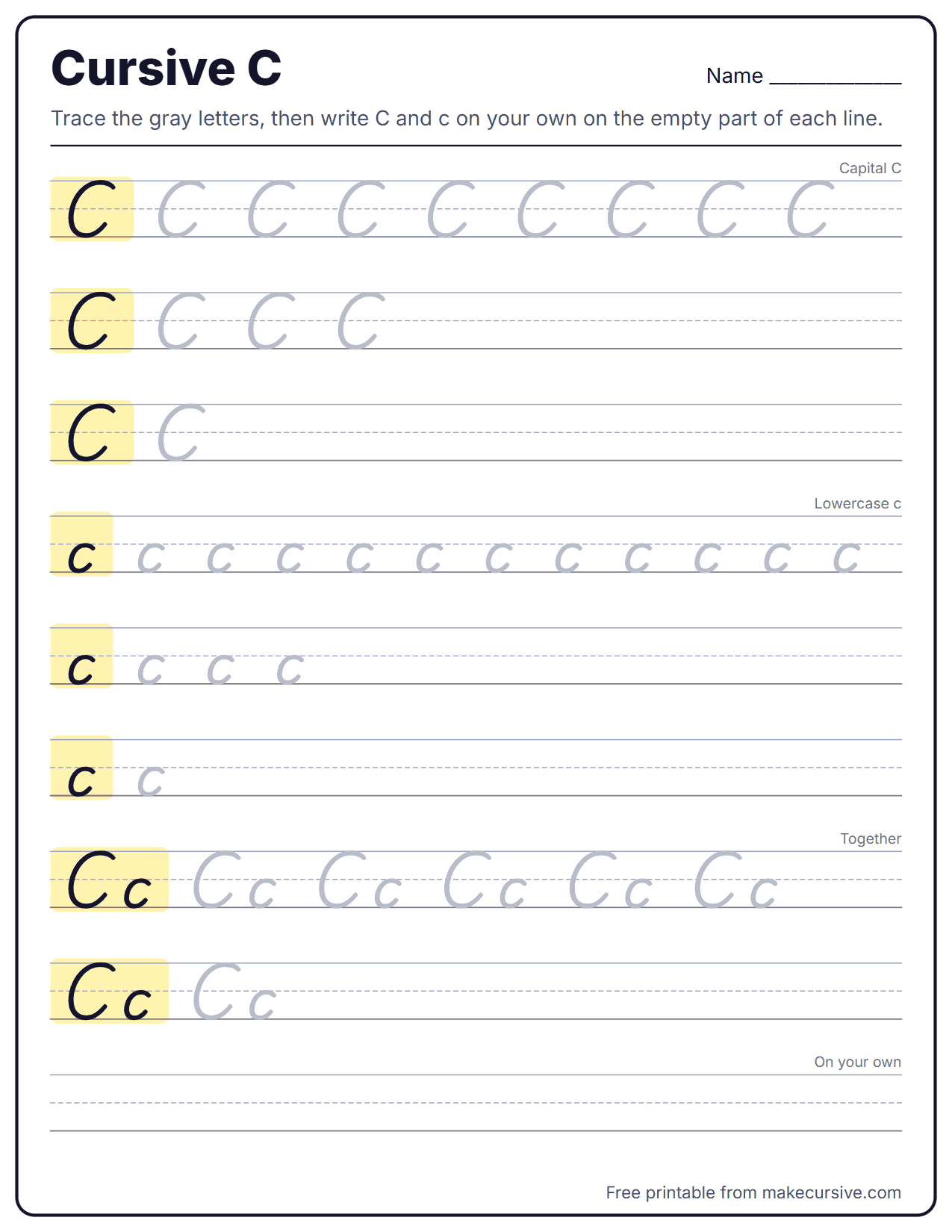
Uppercase, lowercase, and pair examples
Compare the capital C, lowercase c, and the Cc pair before you print or export practice text.
Capital C in cursive
Capital C is one large downcurve with a small starting hook and a joining exit. Its opening movement is shared with capital A, O, and E, so a confident C makes those capitals easier too.
Capital C, stroke by stroke
- Start a little below the top line, toward the right side of the letter.
- Curl up to the top line with a small hook; some models draw it as a tiny loop.
- Downcurve: sweep left and down in a wide arc to the baseline.
- Undercurve along the baseline and up toward the midline.
- Run straight into the next lowercase letter. C is a joining capital in Zaner-Bloser and D'Nealian-style cursive.
Capital C vs E and O
E starts with the same hook and curve, then folds into a small loop halfway down before a second curve. A dent or loop in the middle of your C makes it read as E. At the other end, a C whose tail curls back up to the start becomes O. Keep one smooth arc with a clear gap on the right.
Where capital C goes wrong
- Closing the curve back to the starting point.
- A starting hook so large it looks like a separate letter.
- An upright, narrow C that ignores the slant of the letters after it.
Lowercase c in cursive
Lowercase c is a short downcurve between the baseline and the midline. The little hook at its top is what separates it from e, and its open right side is what separates it from a and o.
Family and height
c is the model letter of the downcurve (c-stroke) family: a, d, g, o, and q all open the same way. It stays inside the x-height, entering on an undercurve from the baseline and leaving on another.
Lowercase c steps
- Undercurve from the baseline up to the midline.
- Make a small hook at the top, moving slightly right and back.
- Downcurve left and around to the baseline.
- Undercurve away into the next letter, leaving the right side open.
c vs e, i, and o
e has a loop where c has a hook; let the hook swell and you have written e. A c with almost no curve can pass for an undotted i. Close the curve and it becomes o, or an a missing its stem.
Lowercase c mistakes
- Starting the curve from the bottom, so the opening faces the wrong way.
- Dropping the hook, which leaves a plain arc that blurs into the connector.
- Writing c as tall as the capital when it follows one.
A4 cursive alphabet practice sheet
Find Cc on the A4 preview, then train the open curve over three days. c is a quick letter, so short, frequent practice works better than one long sitting.
Day 1: open arcs
Print a line of lowercase c and a line of capital C. After tracing, check that you could draw a vertical line through the gap on the right of each one.
Day 2: c beside e
Alternate the two letters in one row (cecece). It forces a deliberate choice between hook and loop.
Day 3: words
Write cat, clock, school, and picnic. Compare every ck, ch, and sc pair with the joining notes below.
Cursive Alphabet Practice
Joining c to other letters
Like a, lowercase c starts at the top of its curve, so the incoming connector has to rise to the midline and turn over before the downcurve. Leaving c is easy; arriving cleanly is the harder half.
oc in clock and doctor
o leaves with a bridge at the midline. Carry it right and fold straight into the c hook. Dipping toward the baseline first adds an extra hump between the letters.
ch in chair and much
From c the undercurve has to climb all the way to the top line for the h loop. Keep the c small so the tall loop has room.
ck in back and duck
k also starts with a tall loop. Rise straight into it; a loop at the midline between c and k makes the pair look like cek.
sc in school and scar
s closes at the baseline, and the connector then climbs to c's hook. Rushed, the two merge into one wide curve.
cc in soccer and accept
Two identical curves with a visible connector. Without it, cc collapses into a single wide o.
Practice words for C
These words move c from the start of a name to the middle and end of common words, with the pairs from the joining notes.
Keep the full set on paper with the cursive alphabet worksheets.
How other handwriting models draw C
Older Palmer and copybook capitals often begin C with a larger loop at the top, and some UK joined styles write lowercase c with no hook at all. This page follows the common American school form.
Cursive C questions
Does cursive capital C connect to the next letter?
Yes, in Zaner-Bloser and D'Nealian-style cursive the exit runs straight into the next lowercase letter, as in Clara. Decorative styles sometimes break the join after a large flourish.
What is the difference between cursive c and e?
c begins with a small hook and stays open; e begins at the baseline and makes a closed loop. Same size, different start.
Should cursive C ever close into an O?
No. The open right side is what makes it C. If the tail meets the starting point, readers will see O.
Which letters start the same way as c?
a, d, g, o, and q. All begin at the top of a downcurve, so practicing c improves the whole group.