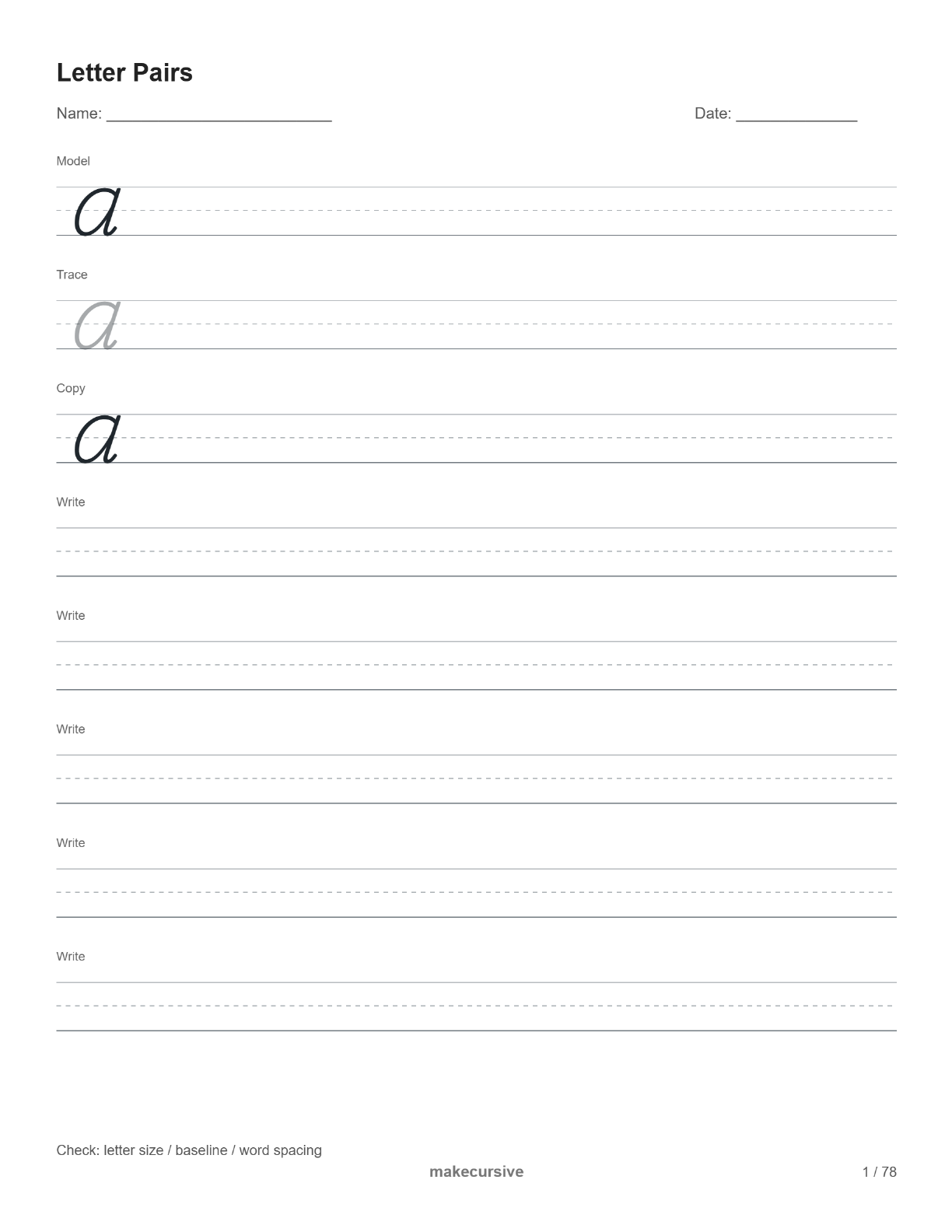
Complete A-Z
78 pages
Three formats in one download.
Printable practice
Download free cursive alphabet worksheets in US Letter or A4. Choose a complete set, one format, or just the letters you need.
Uppercase, lowercase, and paired practice. No sign-up.
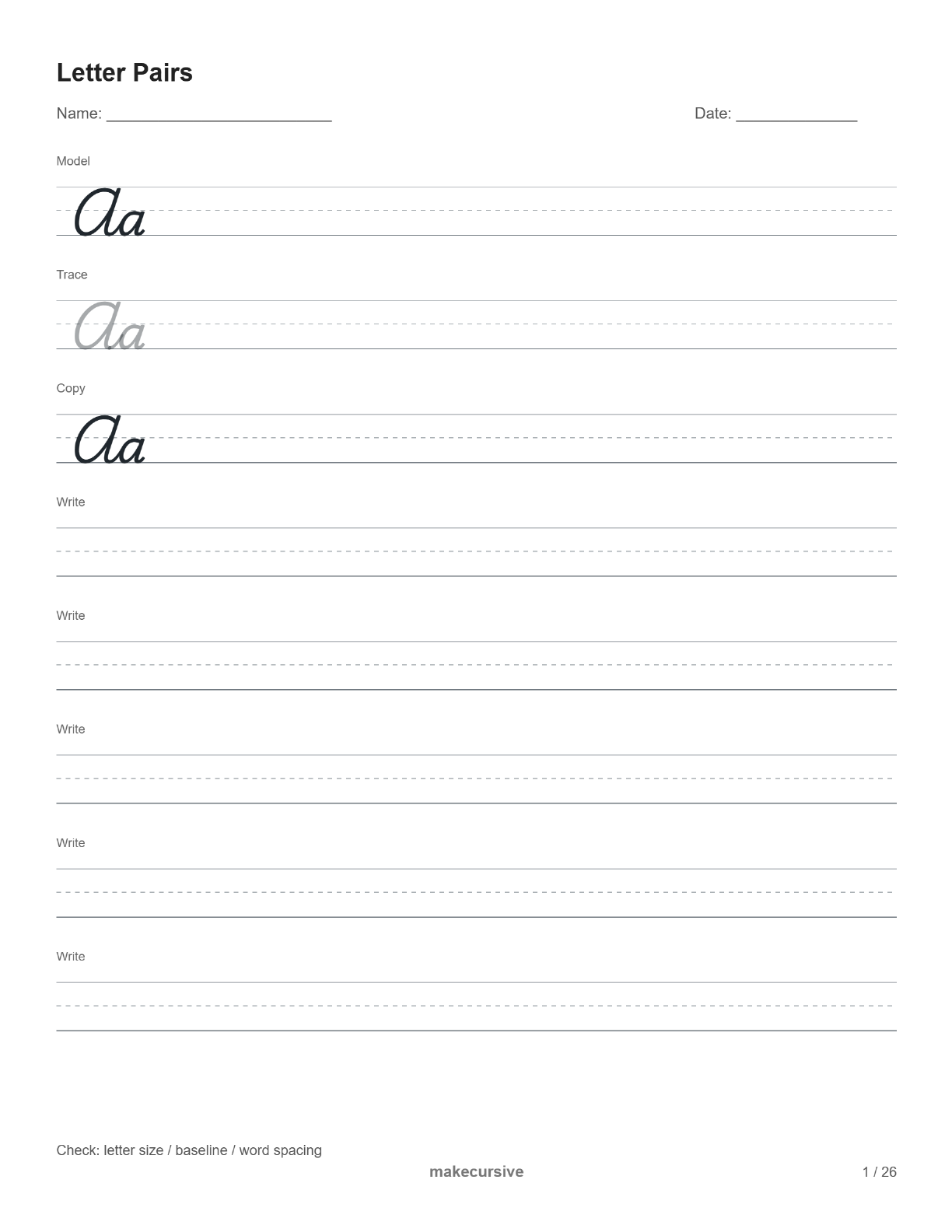
All packs use the same font and are available in both paper sizes. Standard packs use medium letters and fill the page with practice rows. Adjust your own set below.
78 pages
Three formats in one download.
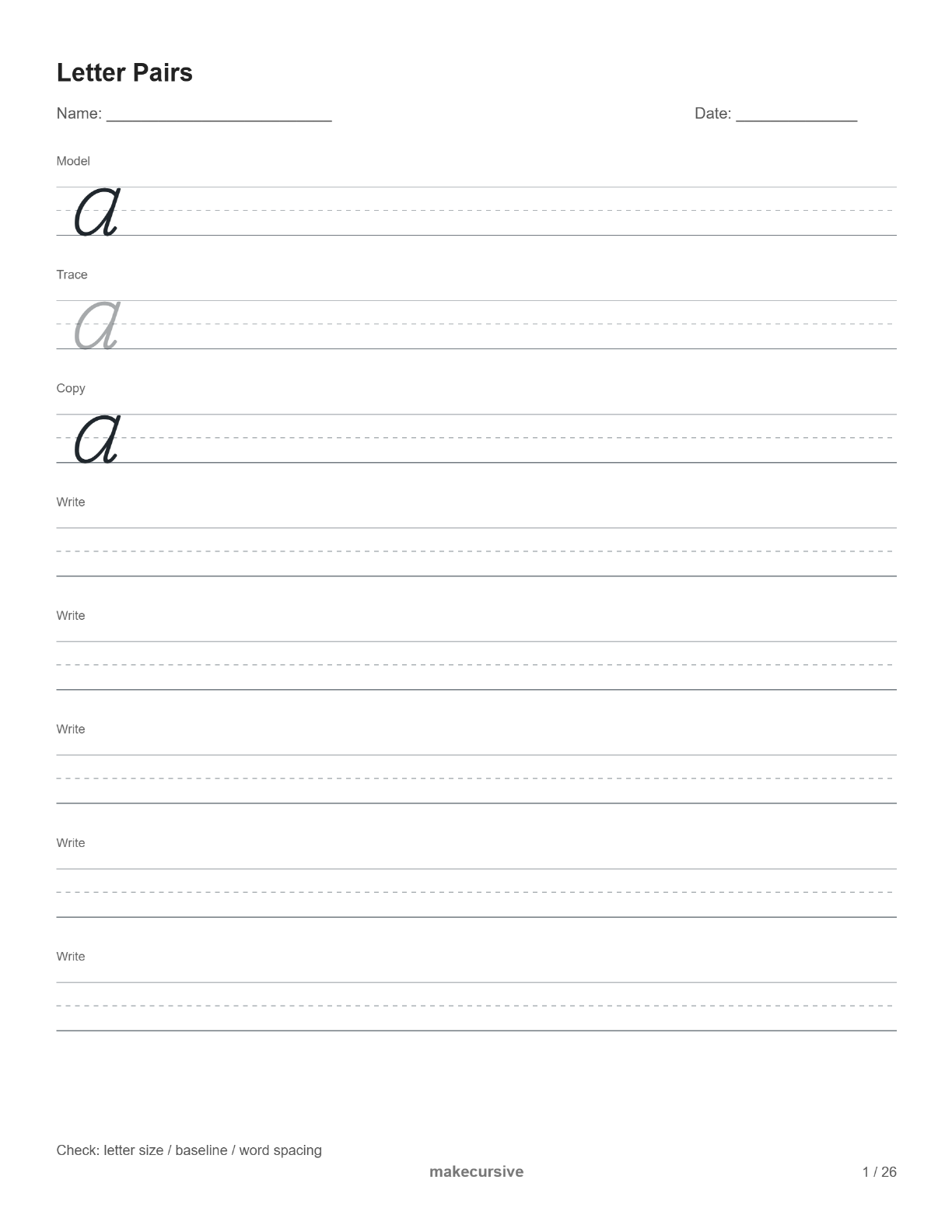
26 pages
One capital letter per page.
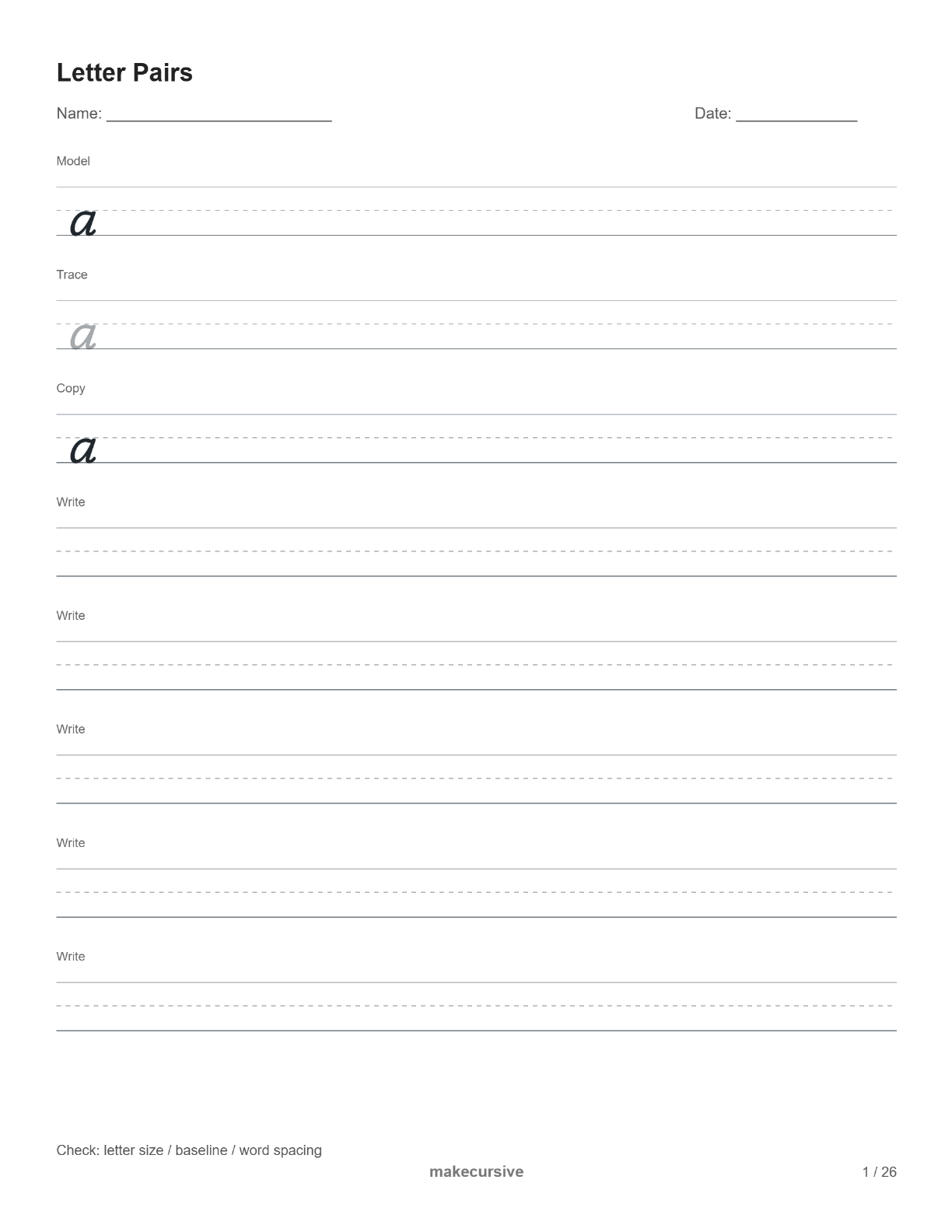
26 pages
One lowercase letter per page.
26 pages
Uppercase and lowercase together.
Select any letters to make a smaller practice set.
Font: Playwrite US Trad
These settings apply to your selected PDF and carry into Customize this set. Every page includes a makecursive footer watermark.
Prefer a ready-made set? Download all 26 letter-pair pages.
These worksheets use Playwrite US Trad. Compare the samples with the handwriting model used at school.
Font samples do not teach stroke order or establish curriculum approval. Read about the Playwrite font project.
Every pack uses the same four-step page: a dark model, a lighter tracing row, a model with space to copy, and blank guide lines. What changes is which letters appear and in what order. Pick the pack that matches what the writer is learning this week rather than printing everything at once.
Most handwriting programs teach lowercase before capitals because lowercase letters make up almost all of a written word. A beginner who can form and join the 26 small letters can already write real sentences, even before every capital is learned.
Cursive capitals vary more between handwriting models than lowercase letters, and several of them (Q, G, I, J, F, T) look little like their printed forms. Print this pack when the writer is ready to start names and sentences, and check each capital against the model used at school.
The Aa-Zz pages put each capital beside its lowercase partner, which helps writers notice size and height differences. They work well as weekly review once both sets have been introduced, or for older learners relearning cursive.
The 78-page pack combines all three formats. It suits a classroom binder or a summer workbook, but it is a lot of paper for one sitting. Print it in sections or use Choose letters to make smaller sets.
The sheets are set in Playwrite US Trad, an open-source handwriting font from the Playwrite project, designed for teaching joined writing. The US Trad style follows the slanted, looped cursive traditionally taught in American schools, so its letters connect the way a hand-written word does rather than sitting apart like a script font.
No font matches every classroom model stroke for stroke. Before using these pages for instruction, compare a few letters that commonly differ between models:
If your school's model differs, use the worksheets for rhythm, slant and spacing practice, and teach the differing letters from the school chart. Each letter guide explains the common variants for that letter.
Going through the alphabet from A to Z is not the easiest route. Lowercase cursive letters fall into families that share an opening stroke, and practicing a family together makes each new letter feel familiar. Use Choose letters above to print one family at a time.
i, t, u, w, then r, s, p and j. These start with the same rising stroke from the baseline and are the gentlest introduction to joining. Pair i and t with u for early words such as it and tie.
e, l, h, k, f, b. These add a loop to the undercurve start: small for e, tall for the rest. Keep e short so it does not turn into l.
a, c, d, g, o, q. These begin by curving back over the top, so the stroke before them must travel up and over. Practice joins such as ta, od and og.
n, m, v, x, y, z. These start with a hump-like overcurve. Compare n and m side by side, and add v and y once the humps are even.
b, o, v and w end high at the midline instead of returning to the baseline, which changes the next join. Review pairs such as br, oa, ve and wo once every family is familiar.
Start with the capitals in the writer's own name and in common sentence starters (I, T, A, W, M), then fill in the rest with the uppercase pack.
The lowercase and uppercase reference pages group every letter by stroke family if you want to plan further.
Ten to fifteen minutes a day works better than an hour once a week. One page per session is enough: model, trace, copy, then a single row of independent writing.
After the blank row, ask the writer to circle their best letter and their weakest one. Repeat only the weak letter next time instead of the whole page.
Tilt the paper so its top leans to the right, keep the hand below the writing line, and accept a slightly more upright slant. Tracing rows help left-handers see the shape without smudging the model.
Slip a page into a clear sheet protector and use a dry-erase marker for repeated tracing. Keep paper copies for the blank-line rows so progress can be compared over time.
Look closely at the letter.

Follow the lighter sample.

Copy from the model.

Try the blank guide lines.

Match the PDF to your paper: US Letter (8.5 by 11 inches) or A4 (210 by 297 mm). Start at 100% scale. Print one test page before the full 78-page set; use your printer's fit setting only if the page edges are clipped.
Choose Customize this set to adjust tracing ink in the worksheet generator. Check the font sample in black-and-white or grayscale and print a test page. Printer settings and paper can affect how faint lines appear.
Yes. Adjust letter size, row spacing and rows per page here. Auto fills the page with rows that fit your letter size; choose a row count for more blank space. Download selected PDF uses the previewed layout. Customize this set carries your letters and layout into the worksheet generator for more options. The complete pack contains three formats; customize one format at a time.
Yes. The complete pack, individual formats and selected-letter PDFs are free and do not require an account. Print copies for personal, family or classroom practice. Compare the letter shapes with your school's model before using them for instruction.
Print a test page before the full 78-page set. The PDF contains high-resolution page images; its practice text is not selectable.