Cursive D
Watch capital D and lowercase d together. Select a step to replay it.
Begin near the upper end of the inner stroke. Follow the slant down and round the small loop at the baseline.
Start at the upper-left hook. Swing over the top and down the right edge, then return around the bowl to the foot loop.
Start under the tall stem at the midline and travel left around the oval. Rise along its right side.
Return to the top of the stem. Bring it down to the baseline, then curl the tip out to the right.
Practice cursive D
Cursive D is really two different designs. Capital D is a looped stem wrapped in one big curve and usually does not join; lowercase d is an a whose stem climbs to the top line and comes straight back down.
- Close the oval, then climb
- Retrace the stem, no loop
- D / d / Dd focus modes
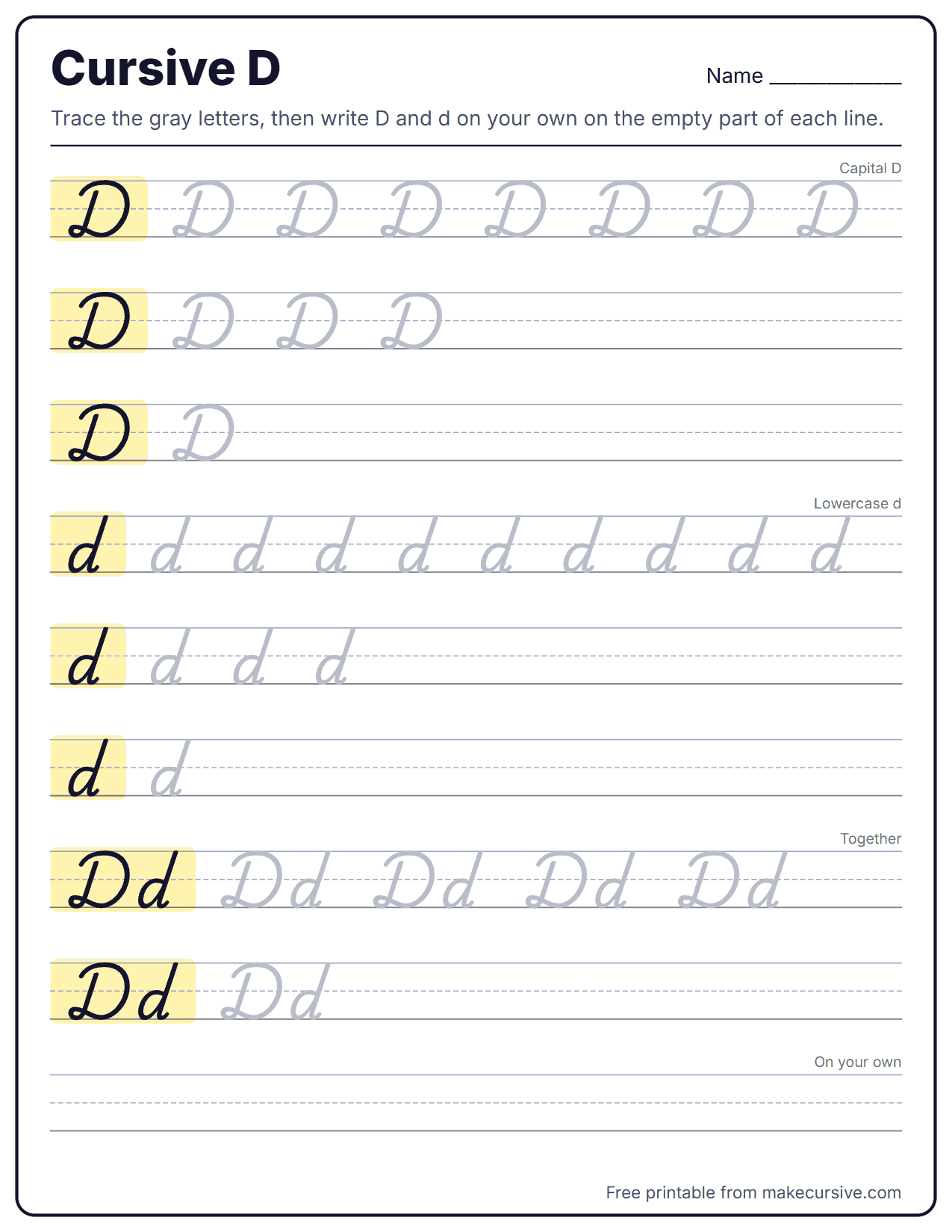
Uppercase, lowercase, and pair examples
Compare the capital D, lowercase d, and the Dd pair before you print or export practice text.
Capital D in cursive
Capital D opens with a slanted stem from the top line, like B, then adds a small loop on the baseline and a single wide curve that wraps back over the top. In Zaner-Bloser-style cursive it is a non-joining capital.
Capital D strokes
- Begin at the top line and slant down to the baseline.
- Make a small loop at the baseline, to the left of the stem.
- Curve right along the baseline, then sweep up the right side in a wide arc to the top line.
- Curve back over the top toward the stem and finish with a small loop that turns out to the right.
- Lift the pen; the next lowercase letter begins on its own, close to the D.
Capital D vs O and L
O is a closed oval with no stem and no baseline loop. L shares D's small loop on the baseline but stays open, exiting to the right along the baseline. If your big curve stops short of the top, the D drifts toward L; if the stem vanishes into the curve, it reads as O.
Capital D mistakes
- Skipping the baseline loop, which leaves a print-style D.
- A narrow bowl that leans into the next letter.
- A dragged joining tail that crowds the a in Dana or David.
Lowercase d in cursive
Lowercase d is a downcurve letter with an ascender. Its oval sits in the x-height like a, its stem rises to the top line and is retraced, and the whole letter depends on closing the oval before the climb.
Family and height
d belongs to the downcurve (c-stroke) group with a, c, g, o, and q. It occupies two zones: oval up to the midline, stem up to the top line, nothing below the baseline. It exits on a baseline undercurve.
Lowercase d steps
- Undercurve to the midline and turn over to the top of the oval.
- Downcurve left, around the baseline, and back up to close the oval.
- Without lifting, continue up the right side to the top line.
- Retrace straight down the same path to the baseline.
- Undercurve out to the next letter.
d vs a, cl, and ol
Stem too short: it is a. Gap between oval and stem: it reads as cl. Loop in the stem: some readers see ol. The target is a closed oval with a tall stem retraced tightly against it.
Lowercase d mistakes
- Lifting at the top of the stem and restarting, which leaves a hook.
- A stem that leans more than the oval, so the letter looks like it is falling.
- A stem shorter than the l or h nearby; all ascenders share the top line.
A4 cursive alphabet practice sheet
Use the A4 preview to compare Dd with Bb, the other letter in the top row whose lowercase form has a tall part and a bowl. Then give d three short sessions with one goal each.
First: closed ovals
Trace a row of a, then a row of d. If every a is closed, d only needs the longer stem.
Second: stem height
Write d beside l and h (dl, ld, dh). Every ascender should touch the top line together.
Third: words
Write dad, good, hand, and ladder. Check the oval of each d, especially in the double d.
Cursive Alphabet Practice
Joining d to other letters
Lowercase d is entered from the top of its oval and left from the baseline. The trouble spots are joins where the incoming stroke must climb and turn over first, plus the doubled dd.
nd in and and hand
n exits on the baseline. The connector rises to the midline, then curves left into the oval. Rushing it opens the top, and the d splits into cl.
od in good and food
o's bridge leaves at the midline. Swing it right and into the downcurve. If it dips toward the baseline first, an extra hump appears between o and d.
ld in old and cold
Coming down from the l loop, the connector climbs only to the midline. The d stem does the tall climbing afterward.
dd in add and ladder
From the first d's exit, curve over into the second oval. Keep the gap the same as between other letters so the pair does not fuse.
dr and de after d
d exits low, so r and e start normally. Keep the r shoulder well below the d stem so it does not look like a second ascender.
Practice words for D
A mix of names and everyday words with d at the start, in the middle, doubled, and at the end.
Print Dd with every other letter pair from the cursive alphabet worksheets.
How other handwriting models draw D
Capital D varies more than most capitals: some models draw it without the baseline loop, and decorative alphabets add big flourishes at the top. Lowercase d is more consistent, though Palmer-era handwriting sometimes loops the stem.
Cursive D questions
Does cursive capital D connect to the next letter?
Usually not. In Zaner-Bloser and D'Nealian-style models it ends with a curl at the top, and the following lowercase letter starts separately beside it.
Why does my cursive d look like cl?
The oval is not touching the stem. Close the oval first, then go straight up the right side without lifting.
Should the stem of lowercase d have a loop?
Not in most modern school models, which retrace it. Some older styles loop it; if yours does, keep the oval closed so it stays distinct from ol.
How tall is lowercase d?
The stem reaches the top line, like b, h, k, and l. The oval stays at the midline, the same height as a and o.