Cursive X
Watch capital X and lowercase x together. Select a step to replay it.
Start at the little upper-left hook. Trace down through the middle and turn up just past the baseline.
Lift the pen. Sweep the diagonal across the middle toward the upper-right tip.
Start at the left hook. Bring the slant down, then round the tail and angle it up.
Lift the pen and cross the letter from the baseline at the left to the right at the midline.
Practice cursive X
Cursive x is written in two parts: a hump-shaped stroke that joins the word, and a straight cross added after the whole word is finished. Capital X follows the same idea at full height and normally does not join.
- Isolate X, x, or Xx in focus mode
- Trace sheet starts with Xx filled in
- Check crossed x in words like next and box
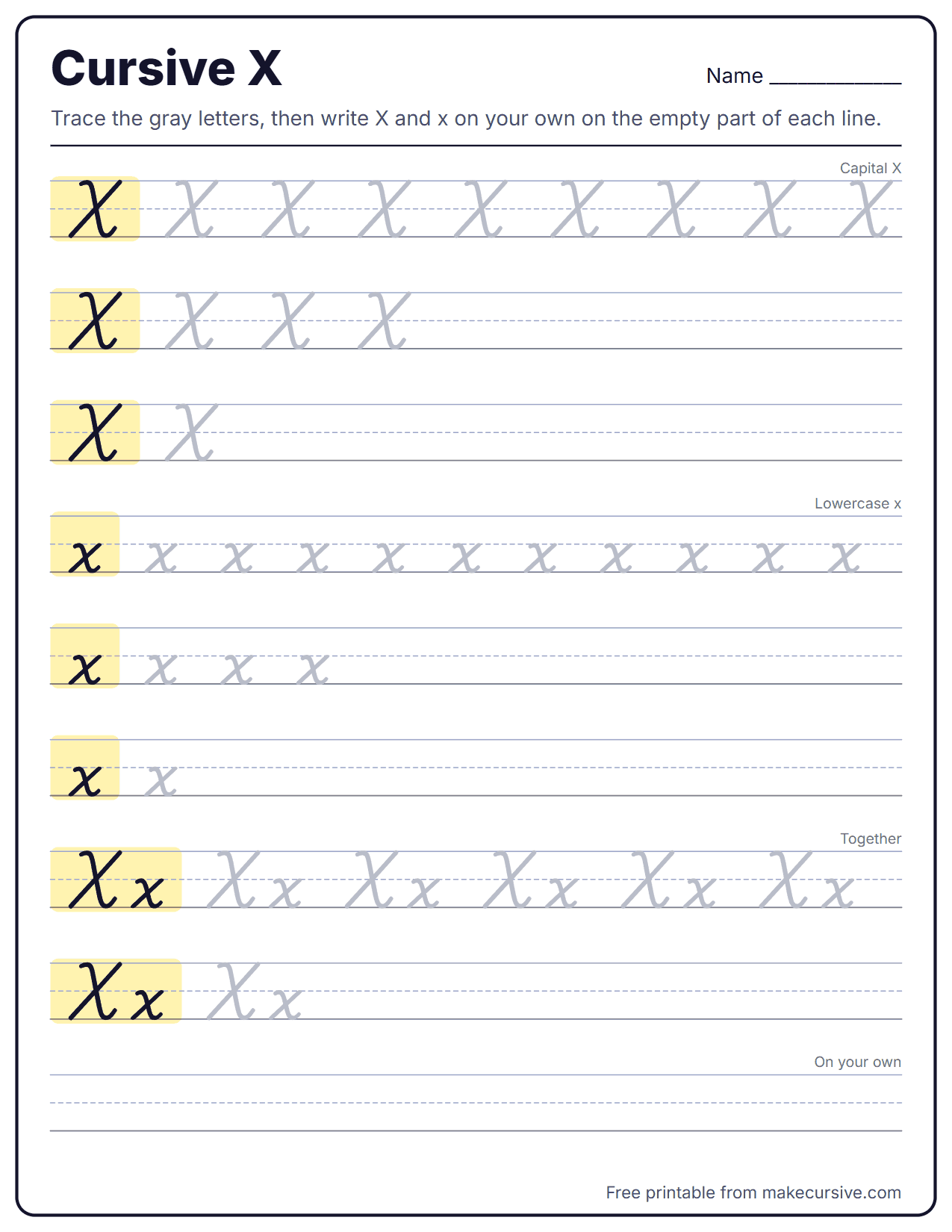
Uppercase, lowercase, and pair examples
Compare the capital X, lowercase x, and the Xx pair before you print or export practice text.
Capital X in cursive
Capital X is a pen-lift letter. The first stroke is a tall curve; the second is a separate diagonal that cuts through it. Few English words start with X, so it shows up mostly in names, initials, and labels.
Capital X stroke steps
- Start just below the top line and overcurve up and to the right.
- Curve over and slant down to the baseline, like the right half of a large n.
- Finish with a short undercurve at the bottom.
- Lift the pen. Draw a straight diagonal through the middle of the first stroke, running the opposite way.
Capital X vs lowercase x and print X
The cursive capital is the lowercase shape stretched to the top line, not a print X with curves added. A print X is two equal straight lines; in cursive, one part is curved and the other straight. Older Palmer-style capitals use a different idea: two curves set back to back, touching in the middle.
Common capital X mistakes
- Crossing too high or too low, so the letter looks lopsided.
- Writing both strokes straight, which reads as print.
- Joining the cross line into the next letter. Start the next letter on its own.
Lowercase x in cursive
Lowercase x behaves like t and i: the joined part goes down with the word, and the extra mark comes later. Writing the cross at the end keeps your hand moving through the rest of the word.
Stroke family and height
An overcurve letter, grouped with n, m, v, y, and z in many school programs. It stays inside the x-height band, between the baseline and the midline, and has no loop.
Lowercase x stroke steps
- Overcurve from the baseline up to the midline.
- Slant down to the baseline.
- Undercurve out to the right and keep writing the word.
- After the word, return and draw a short straight cross through the slant.
x vs n vs v
Before it is crossed, x is a single hump, much like one arch of n, and close to a v with no checkstroke. That is why a forgotten cross is the most common x error: the word suddenly seems to contain n or v instead.
Common lowercase x mistakes
- Forgetting the cross entirely.
- A cross so long that it touches the next letter.
- Stopping mid-word to cross, which breaks the rhythm.
Joining x to other letters
The overcurve start lets x accept an upstroke from almost anything, and its undercurve exit leaves from the baseline, so the next letter enters normally. The real work is spacing and remembering the cross.
ex in next, exit, extra
The exit of e rises straight into the overcurve of x. Keep the e small; a tall loop crowds the hump.
ox in box and fox
The o ends with a bridge at the midline. Run the bridge right, then drop into the slant of x without adding a second hump.
xt in next and text
Two crosses wait until the end. Make them separately: a short cross for x, a level bar for t.
xi in taxi and exit
A dot and a cross land next to each other. Leave enough space between x and i so the dot does not sit on the cross.
x at the end: six, relax
Finish with a short exit, then cross. A long tail makes the cross harder to place.
A4 cursive alphabet practice sheet
Use the alphabet preview to see where Xx sits, then print an x sheet that mixes crossed and uncrossed forms so you can check every cross.
Hump first, cross last
Trace a full row of uncrossed x shapes, then go back and add every cross.
Words, not single letters
Because x is rare, move to short words like box and six early.
Cursive Alphabet Practice
How to practice a rare letter like x
You will not write x often, so a few focused sessions are enough to make it reliable.
- Separate the two parts. In focus practice, look at lowercase x and write ten humps without crossing them. Then cross all ten in one pass, aiming for the center of each slant.
- Practice the entries. Print a trace sheet with ex, ox, and ax. These are the letters that most often come before x in English.
- Finish whole words. Write "Max fixed the box next to the taxi." Do not cross anything until the full sentence is written, then add every x cross and t bar, and dot the i.
Practice words for X
Short, common words where x sits after different letters, plus names for the capital.
Add Xx to a full alphabet review with the cursive alphabet worksheets.
How other handwriting models draw X
We describe the common American school form. Some adults write lowercase x as two small curves back to back so it needs no pen lift, and older copybooks did the same for the capital. The direction and angle of the cross also vary between programs.
Cursive X questions
When do I cross the lowercase x?
After the whole word is written, at the same time you cross t and dot i and j. Crossing mid-word forces an extra pen lift and usually makes the next join uneven.
Does capital X connect to the next letter?
Usually not. Capital X is made of two strokes and ends with the cross line, so you start the following letter separately, as in Xavier.
Why does my cursive x look like an n or a v?
Most likely the cross is missing or too faint. The first stroke of x is a single hump, so without a clear cross through its center it can pass for part of n or a v.
Can I write cursive x without lifting the pen?
Yes, in personal handwriting. Some people write two small curves back to back, like a reversed c touching a c. It is readable, but school worksheets usually expect the crossed form.
What words are good for practicing x?
Short, everyday words such as box, six, next, exit, taxi, and relax. They place x after o, i, e, and a, which covers the joins you meet most often.