Cursive V
Watch capital V and lowercase v together. Select a step to replay it.
Round the short left entry, glide down to the baseline, then rise along the right edge and turn out high.
Enter at the left shoulder, sweep down into the bowl, then rise up the right side. Keep the end high for the join.
Practice cursive V
Cursive v is small but fussy: lowercase v ends with a checkstroke and a high bridge that changes how the next letter begins, and capital V usually stands alone. Learn both forms, then drill the joins in words like very, over, and seven.
- Switch between V, v, and Vv in focus mode
- Trace lines open with Vv already filled in
- Try the ve, ov, and vi joins in the generator
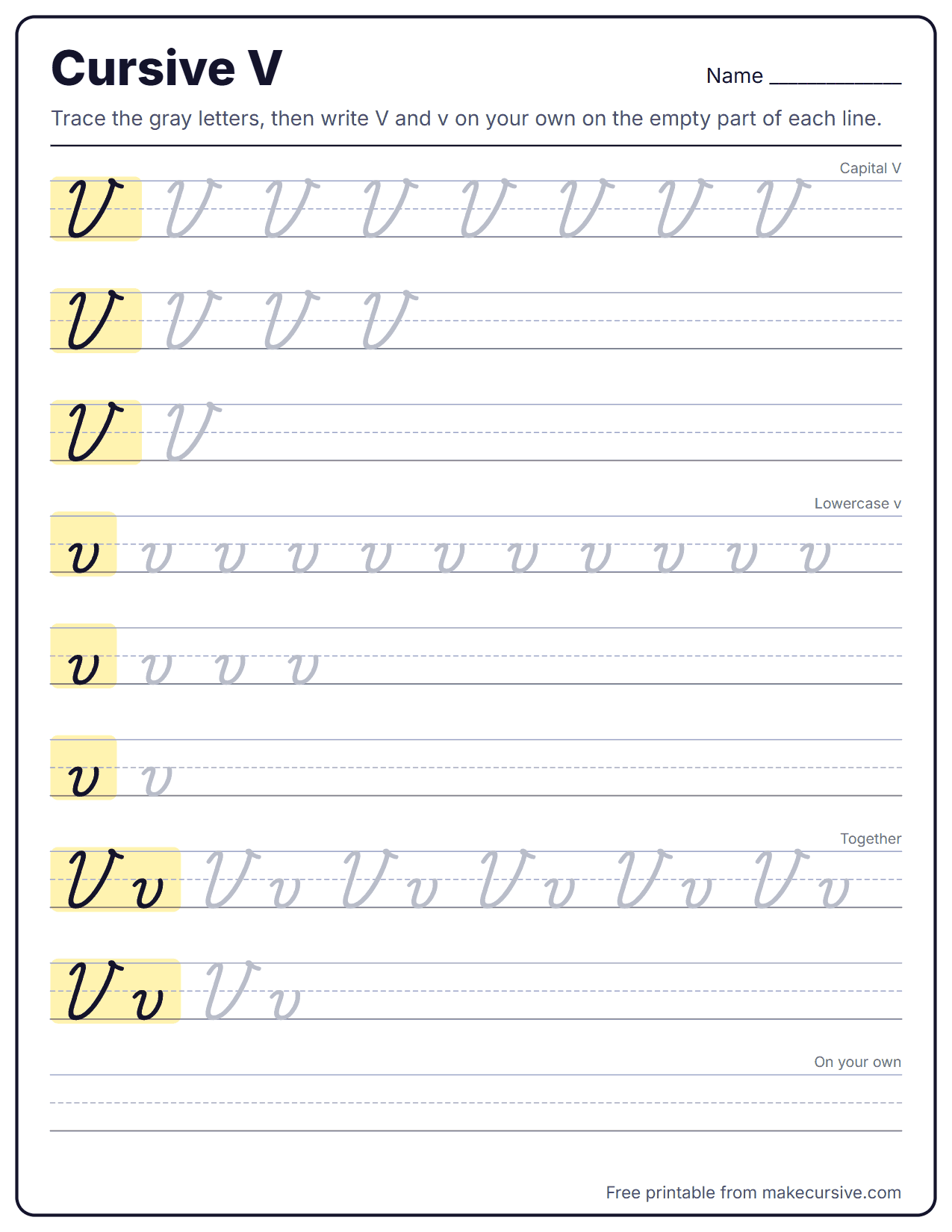
Uppercase, lowercase, and pair examples
Compare the capital V, lowercase v, and the Vv pair before you print or export practice text.
Capital V in cursive
Capital V is a cane, one long slant into a valley, and an upswing that stops near the top line. Because it ends high on the right, most school models leave it unjoined.
Capital V stroke steps
- Just below the top line, make a small cane: up and over to the right, like the start of capital N.
- Slant down to the baseline, rounding the bottom slightly.
- Undercurve back up to near the top line.
- Stop. Some styles add a tiny curl; nothing travels back down.
Capital V vs capital U
V and U share their first three movements: cane, slant down, undercurve up. U then slants back down to the baseline and joins the next letter; V simply ends at the top. Add a right-hand downstroke to V and readers see U.
Common capital V mistakes
- Skipping the cane, leaving a print V among cursive lowercase.
- Stopping the upswing at the midline, so V is no taller than v.
- Dragging a long connector down from the top of V. A short gap reads better.
Lowercase v in cursive
Lowercase v starts with an overcurve like n, m, x, y, and z, and ends like b, o, and w: a checkstroke at the midline and a sideways bridge. That bridge makes v harder to join than to write.
Stroke family and height
An x-height letter: it stays between baseline and midline. It opens with an overcurve (a small hump) and closes with an undercurve plus checkstroke.
Lowercase v stroke steps
- From the baseline, overcurve up to the midline.
- Slant down to the baseline.
- Undercurve back up to the midline.
- Make the checkstroke: a tiny retrace or closed loop at the top right.
- Leave with a short, nearly level bridge along the midline.
v vs u vs r
Cursive u has two undercurves and leaves from the baseline; v has one valley and leaves from the midline. Cursive r also has a shoulder near the midline, but its exit drops to the baseline. A sagging v exit reads as r; a second cup reads as u or w.
Common lowercase v mistakes
- No checkstroke, so the bridge has no clear start.
- A bridge that dives to the baseline, turning ve into ue.
- A wide overcurve entry that looks like n.
Joining v to other letters
Going into v is easy; its overcurve accepts an upstroke from almost any letter. Coming out is harder: the bridge leaves you at the midline, so the next letter cannot start with its usual baseline undercurve.
ve in very, seven, have
Start the e from the bridge: dip slightly, then rise into a narrow loop. Dropping to the baseline first makes the e too tall.
vo in voice and over
Travel right, then curve back over into the top of the o. The o has its own bridge, so voice has two midline exits in a row.
va in value and Vanessa
Carry the bridge past where the a begins, then swing back left into its downcurve. A short bridge squeezes the a into the v.
ov in love, over, cover
The o bridge flows straight into the overcurve of v. Keep it level and do not add a loop between them.
A4 cursive alphabet practice sheet
The A4 preview shows where Vv sits in the full alphabet. Use it as a quick reference, then print a v-only sheet built around the bridge exit.
Trace the checkstroke
Light trace rows of lowercase v let you feel the small loop before the bridge.
Capital V and U side by side
Alternating V and U on one line makes the missing second downstroke obvious.
Cursive Alphabet Practice
Practice plan for V
Short sessions suit a letter whose main problem is the join. Spend about ten minutes on each step.
- Shape. Open focus practice in the lowercase view and copy v until the checkstroke and bridge stay at the midline. Add two rows of capital V that finish near the top line.
- Pairs. Print a trace sheet with ve, vo, va, ov, and vi. Trace a row of each, write a row freehand, and circle any pair where the bridge dropped.
- Words. Write very, over, seven, and voice three times each, then "Victor gave Vera seven violets." Compare with the generator preview and fix the weakest join.
Practice words for V
Each word puts v in a different position, so you meet every join above.
For a paper reference of all 26 pairs, print the cursive alphabet worksheets and keep the Vv row next to your practice page.
How other handwriting models draw V
These steps follow the common American school model. Palmer-style capitals often open V with a larger looped flourish, and some UK joined styles write v with a sharp point and no checkstroke. Several handwriting fonts also leave out the bridge.
Cursive V questions
What is the little loop at the top right of lowercase v?
It is the checkstroke: a tiny retrace or closed loop at the midline before the pen moves sideways. It gives the bridge a clear start.
Should capital V connect to the next letter?
In most school models, no. It ends near the top line, so lift the pen and give the next letter its own entry stroke. A signature style may add a connector if it stays readable.
Why does my cursive v look like a u or an r?
It reads as u when the bottom gains a second cup, and as r when the exit drops toward the baseline. Keep one narrow valley and a level bridge.
How do I join v to e in words like very and seven?
Start the e from the bridge, not the baseline: dip a little, loop up, and come back down. Practice ve as a pair first.
Is lowercase v just the end of a w?
Nearly. Cursive w ends with the same checkstroke and bridge, but it opens with an undercurve and has two cups, while v opens with an overcurve hump.