Cursive W
Watch capital W and lowercase w together. Select a step to replay it.
Round the short left hook, sweep down to the baseline, and rise sharply to the middle point.
Retrace down the middle slant. Round the second bowl, then rise to the upper right and carry out the hook.
Start high on the left. Round the first turn at the baseline and rise to the middle of the letter.
Retrace the middle slant. Round the second turn and rise up the far side to a high exit.
Practice cursive W
Cursive w is a u that finishes high: its cups open upward, and the last upstroke ends in a checkstroke and midline bridge. Capital W adds a second valley to V and usually stands apart from the next letter.
- Compare W, w, and Ww in focus mode
- Trace sheet opens with Ww filled in
- Test wr, wo, and wh in the generator
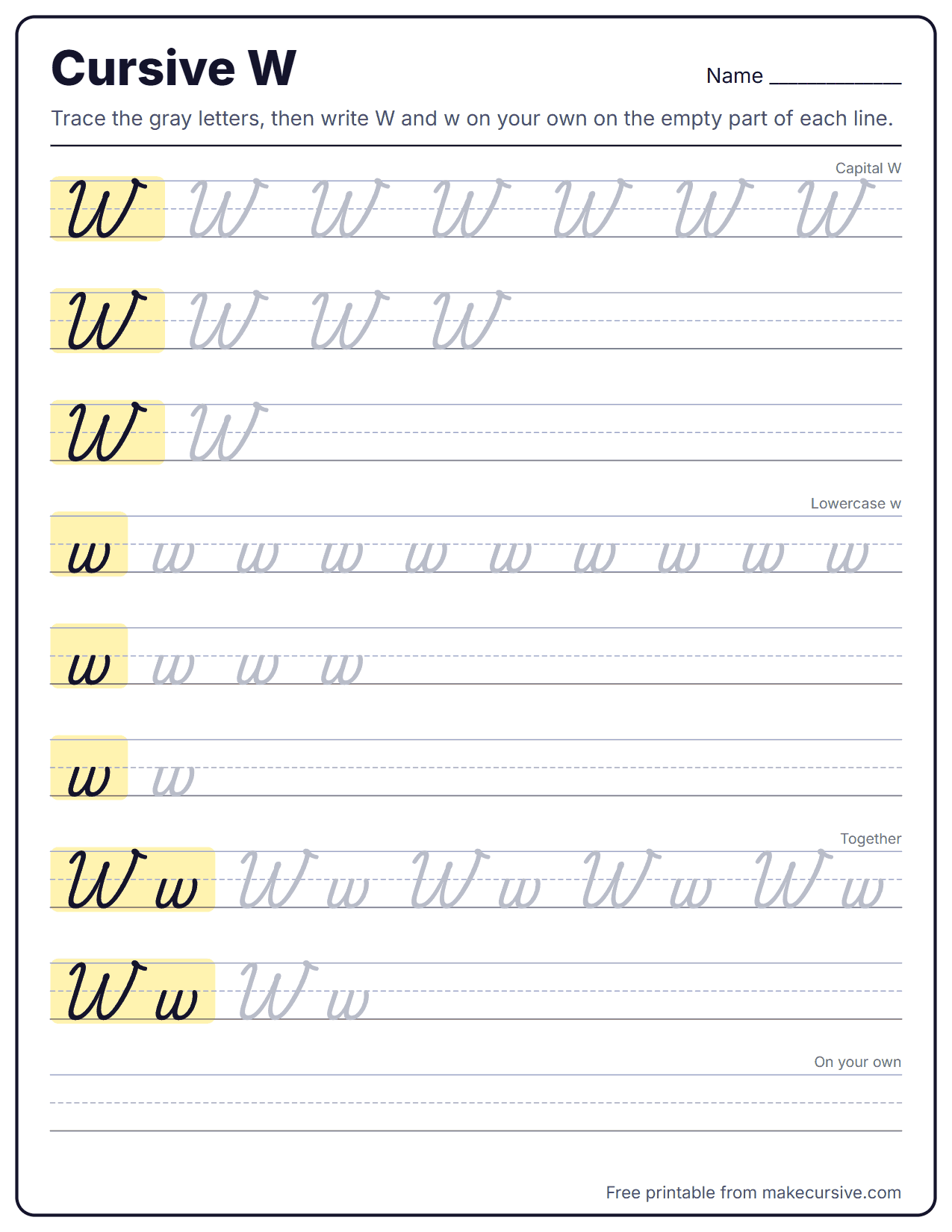
Uppercase, lowercase, and pair examples
Compare the capital W, lowercase w, and the Ww pair before you print or export practice text.
Capital W in cursive
Capital W is a wide letter with two valleys under one cane. It ends at the top right, so in most school models the following letter starts after a small gap instead of a connector.
Capital W stroke steps
- Start with a short cane just under the top line.
- Slant down to the baseline.
- Undercurve up to the middle peak, which many models keep slightly lower than the top line.
- Slant down to the baseline again.
- Undercurve up to the top line and finish with a small curl to the right. Lift the pen.
Capital W vs capital M
The two are mirror ideas. Cursive M is built from arches that go over the top and come down; W is built from cups that dip under and climb back up. Think "under, under" for W and "over, over" for M.
Common capital W mistakes
- Letting the middle peak rise above the outer strokes, which looks crowded.
- Unequal valleys, one wide and one narrow.
- Forcing a join from the top curl down to the baseline.
Lowercase w in cursive
Lowercase w starts like u, with an undercurve from the baseline, but its final upstroke climbs to the midline and ends with a checkstroke and bridge, just like v, o, and b.
Stroke family and height
An undercurve letter that lives in the x-height band. Its two bottoms are rounded cups, not the arches of m and n. If you learned w as "two humps," flip the humps over in your mind: they open upward.
Lowercase w stroke steps
- Undercurve from the baseline to the midline.
- Slant down and round the first cup.
- Undercurve up to the midline and slant down for the second cup.
- Undercurve up once more.
- Checkstroke at the midline, then a short level bridge.
w vs u vs v
Cursive u and w have the same two cups. The difference is the ending: u exits from the baseline, w climbs and bridges at the midline. Cursive v has a single valley and an overcurve start, so a w missing one cup reads as v.
Common lowercase w mistakes
- Skipping the checkstroke, so w becomes u.
- A second cup smaller than the first.
- Letting the bridge slide down into the next letter.
Joining w to other letters
Because w ends on the midline, every letter after it has to begin from up there. These are the pairs that trip people up most often in everyday words.
wr in write and wrong
From the bridge, rise a little to the point of the r, add its small shoulder, then slant down. Keep the bridge short or the r drifts away from the w.
wo in two and word
Move right along the midline and curve back over into the top of the o. Both letters end with bridges, so two finishes high, too.
we in were and went
The e starts from the bridge with a shallow dip and a narrow loop. A deep dip makes we look like "ue".
wh in what and when
The bridge sweeps straight up into the tall loop of h. Keep that loop slim so it does not swallow the w.
ow in now and snow
The o bridge replaces the first undercurve of w. Go straight into the first slant down without an extra loop.
A4 cursive alphabet practice sheet
Find Ww in the full alphabet preview, then print a sheet that alternates u and w so the bridge ending becomes automatic.
u and w rows
Write u, then the same cups as w with a checkstroke. Repeat across the line.
Blank lines for wr
Switch to blank practice lines once wr and wo feel natural.
Cursive Alphabet Practice
Practice plan for W
Three short sittings, each building on the one before.
- Cups and checkstroke. Fill a line alternating u and w. Every w should be the same width as two u cups plus a small bridge. Then write a line of capital W, keeping both valleys equal.
- Hard joins. Use the trace worksheet for wr, wo, we, wh, and ow. Say the ending out loud as you write: "cup, cup, check, bridge."
- Real text. Copy "Wendy wrote two words when Walter was away." Preview the same sentence in the generator, then rewrite only the words whose w joins look weakest.
For a longer walkthrough with a five-minute routine and extra word lists, read how to write W in cursive. This page stays the quick reference for strokes and joins.
Practice words for W
Chosen to cover w at the start, in the middle, and at the end, plus the bridge joins above.
Keep the Ww row from the cursive alphabet worksheets beside you as a model while you write.
How other handwriting models draw W
This page follows the common American classroom form. Palmer capitals often open W with a large loop, and some UK joined styles drop the checkstroke.
Cursive W questions
Is lowercase w in cursive made of humps or cups?
Cups. In school cursive the bottoms of w are rounded undercurves that open upward, like u, while the arches of m and n open downward.
Does capital W connect to the next letter?
Usually not. Capital W ends with a small curl at the top right, so you lift the pen and start the next letter with its own entry stroke, as in Walter or Wendy.
How do I write wr in words like write and wrong?
Keep the bridge short, rise slightly to the point of the r, make its little shoulder, and slant down. Drill wr as a pair first.
Why does my cursive w look like a u?
The ending is missing. A u exits from the baseline; a w climbs back to the midline, makes a checkstroke, and leaves with a bridge.
Should the middle point of capital W be as tall as the sides?
It can be, but many school models keep it a little lower than the outer strokes. What matters more is that both valleys are the same width and reach the baseline.