Cursive B
Watch capital B and lowercase b together. Select a step to replay it.
Sweep up from the short entry on the left, turn at the top, and pull the slanted stem to the baseline.
Return to the upper stem. Make the small upper bowl, turn at the middle, and round the wider lower bowl back to the left.
Rise from the baseline into the tall loop, come down the left side, and round the open bowl. End high, where the next letter can join.
Practice cursive B
Cursive B is the first letter of the alphabet that ends high. Lowercase b finishes with a small checkstroke at the midline, so the letter after it has to start from a level bridge instead of the baseline.
- Tall loop to the top line
- Checkstroke exit at the midline
- B / b / Bb focus modes
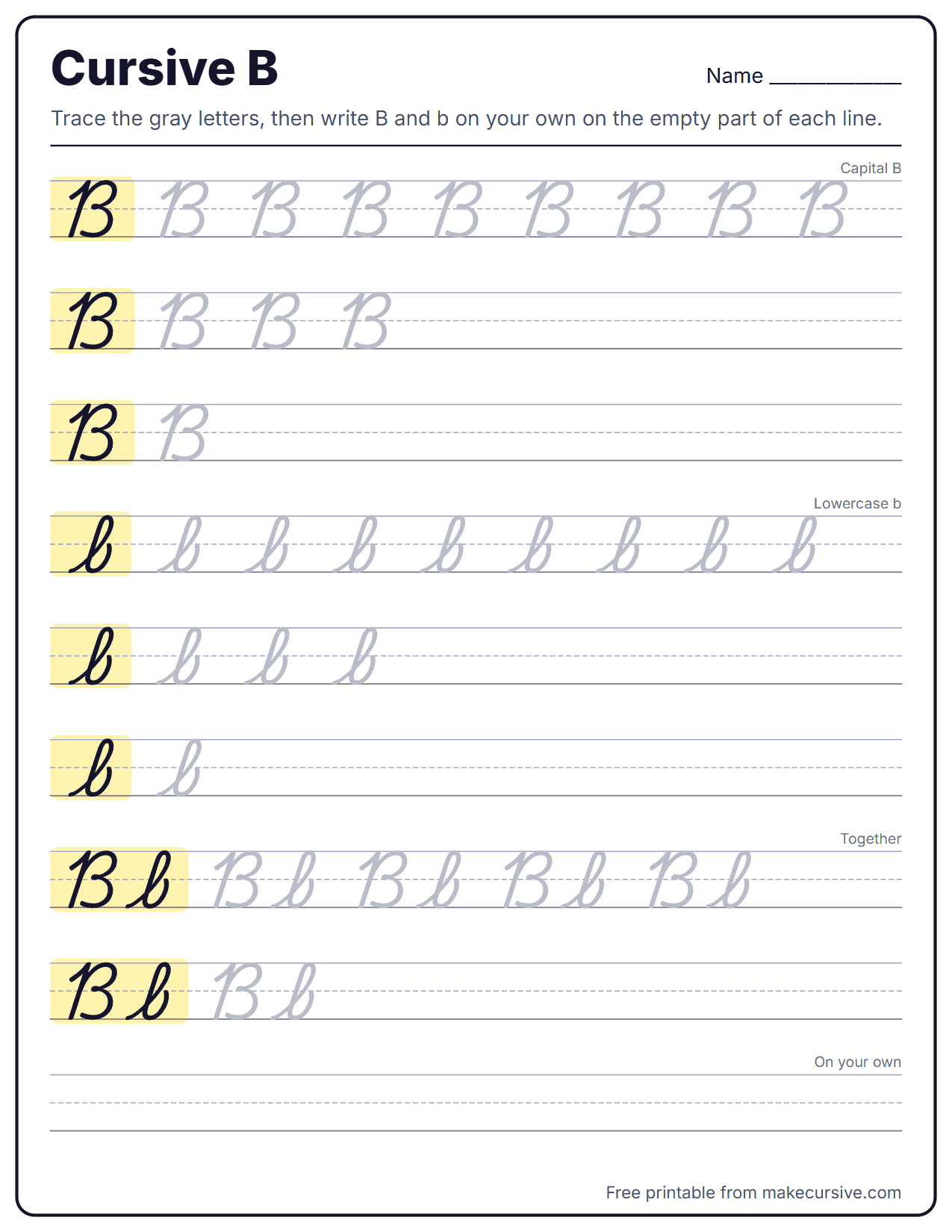
Uppercase, lowercase, and pair examples
Compare the capital B, lowercase b, and the Bb pair before you print or export practice text.
Capital B in cursive
Capital B is a slanted stem with two bumps stacked against it, the lower one larger. In Zaner-Bloser-style cursive it is one of the capitals that usually stands apart from the rest of the word.
How to form capital B
- Begin at the top line and pull a slanted stem down to the baseline.
- Retrace the stem back up to the top line without opening a gap.
- Curve right into the upper bump and make a small loop where it meets the stem near the midline.
- Curve forward into a wider lower bump that rests on the baseline, then end with a short stroke to the right.
Most school models lift the pen here and start the next letter close by; some Palmer-style and signature hands add a connecting tail.
Capital B vs P and R
All three share the stem and upper bump, so check the finish. P stops after the top bump; R adds a leg kicking out to the right. Only B has a second closed bump on the baseline. Make it small or open and B reads as R.
Capital B trouble spots
- Two bumps of equal size, which makes the letter look like a 3 stuck to a line.
- An unretraced stem that leaves a thin loop on the left.
- Forcing a join your model does not use, which squashes the lower bump.
Lowercase b in cursive
Lowercase b combines a tall loop, as in l, with a small closed bowl at the bottom. The ending is what sets it apart: it stops at the midline with a tiny checkstroke rather than returning to the baseline.
Family and height
b is an undercurve loop letter, usually taught with l, h, k, and f. It is an ascender: the loop reaches the top line and the bowl sits below the midline. It shares its midline bridge exit with o, v, and w.
Lowercase b steps
- Undercurve from the baseline up to the top line.
- Loop back to the left and slant straight down to the baseline.
- Undercurve up and to the right to the midline, closing a small bowl.
- Checkstroke: a tiny dip and turn to the right at the midline.
- Carry that level stroke into the next letter.
b vs l, h, and f
Without the bowl, b becomes l. Open the bowl into a hump that returns to the baseline and you have h. Push the downstroke below the baseline into a lower loop and it reads as f.
Lowercase b mistakes
- Letting the exit sag to the baseline, so the bowl looks open.
- A loop squeezed into a single line, which looks like a printed b.
- Skipping the checkstroke, so the next letter joins from the side of the bowl.
A4 cursive alphabet practice sheet
Compare Bb with its neighbors on the A4 alphabet preview, then work through three short rounds. The goal is a b whose exit stays up at the midline every time.
Round 1: loop and bowl
Fill one traced line with lowercase b and one with capital B. Check height only: loops touch the top line, bowls tuck under the midline.
Round 2: bridge pairs
Print be, bo, br, bi, ba, and bl. Think "check, then carry" each time you leave a b.
Round 3: words
Write baby, bread, robot, and table. Circle any b whose exit dropped and rewrite that word.
Cursive Alphabet Practice
Joining b to other letters
Every b join comes from its high exit. The connector leaves the checkstroke at the midline and travels sideways, so the next letter's usual baseline start is replaced by a bridge.
br in bread and brown
r normally climbs from the baseline to a small shoulder. After b the bridge is already at the midline, so the shoulder becomes a little lift just above it before the drop. Without that lift, br looks like bv.
be in best and number
From a bridge, dip slightly below the midline, then loop back up for the e. Looping straight off the bridge gives a flat oval, and best starts to look like bost.
bo in robot and about
Two bridge letters in a row. Keep the connector short and level, close the o at the top, then leave with another bridge.
ba and bu
For a, ride the bridge right, then curve over into the downcurve. For u, the bridge must dip to the baseline first; staying high squeezes the u into a v.
Into b: ab, ob, rb
After a baseline letter, the undercurve simply climbs to the top line. After o, the bridge swings up into the tall loop and needs a little extra room.
Practice words for B
Each word puts b in a different position or next to a different bridge partner.
Print Bb with the rest of the alphabet from the cursive alphabet worksheets.
How other handwriting models draw B
Models disagree most about capital B: some join it to the next letter, some never do. UK joined styles often drop the loop from lowercase b. One quirk of copyable text: the script capital B (ℬ) comes from the older Letterlike Symbols block rather than the main math script set, so it can look slightly different from the letters around it.
Cursive B questions
Does cursive capital B connect to the next letter?
Usually not in Zaner-Bloser-style school cursive: the lowercase letter starts close beside it. Palmer-style and signature hands sometimes add a tail that joins.
Why does lowercase b end at the midline?
The checkstroke closes the bowl, and leaving from that point keeps the bowl readable. Dropping to the baseline would reopen it.
Why does my br look like bv?
The r has no shoulder. After the bridge, lift slightly above the midline before the r comes down.
Which letters share the b exit?
o, v, and w also leave from the midline, so practicing b joins makes those letters easier.