Cursive P
Watch capital P and lowercase p together. Select a step to replay it.
Begin at the left entry and turn at the top into the slanted stem. Pull it down to the baseline.
Return to the upper portion of the stem. Swing over the top, around the right curve, and end below the middle of the bowl.
Ride up the short entry, turn at the top, and carry the slant into the descending loop. Trace back up toward the middle.
From the returning stem, sweep up and over the small bowl, then curl back to the stem.
Practice cursive P
Cursive P is a stem-and-bowl letter. Lowercase p drops below the baseline and comes back up to close its bowl, while capital P is a tall stem with a bowl at the top that usually does not join.
- Show P, p, or Pp at full size
- Step ahead to Q to compare descenders
- White noise for steady stem practice
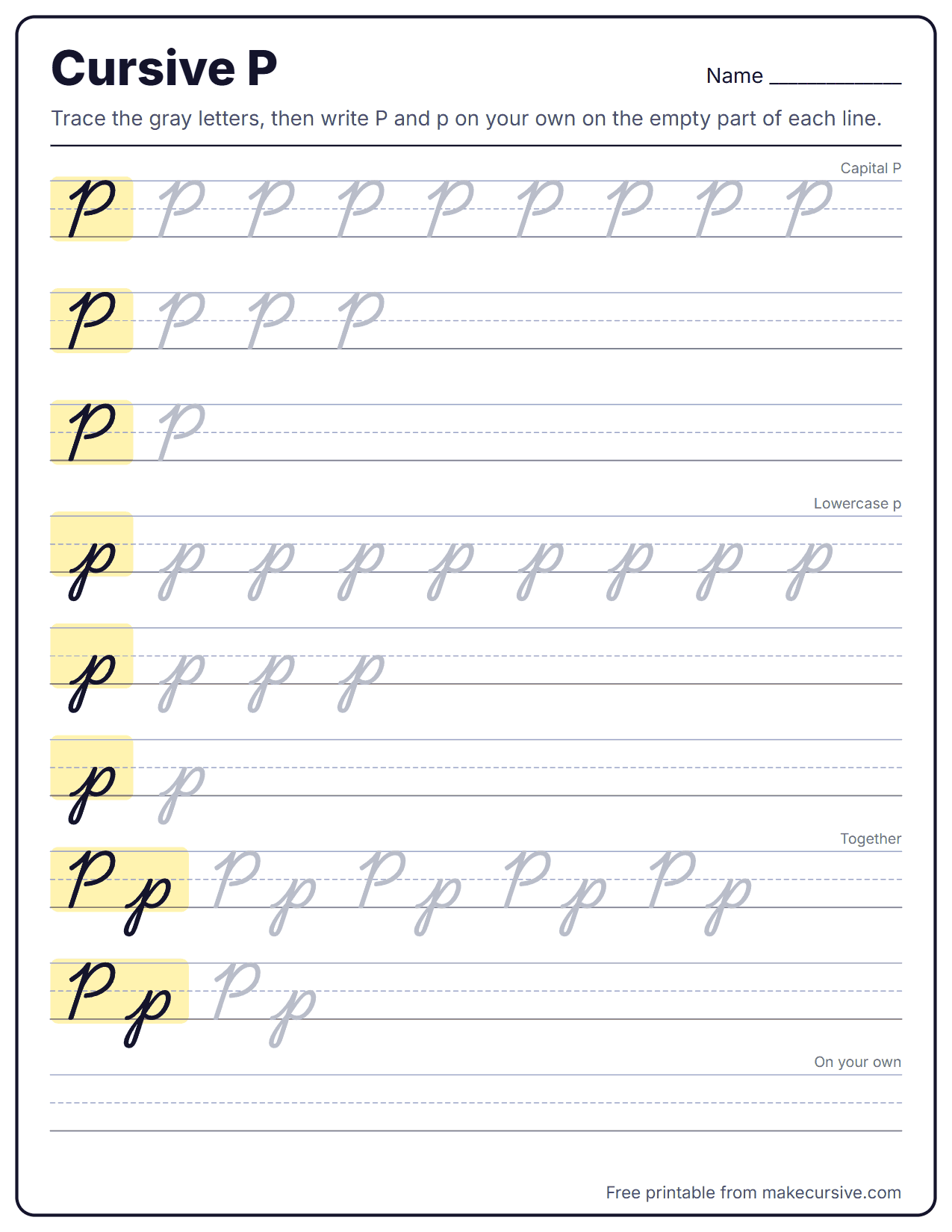
Uppercase, lowercase, and pair examples
Compare capital P, lowercase p, and Pp. The lowercase stem reaches below the baseline, while the capital rests on it.
Capital P in cursive
Capital P in American school cursive stays close to its printed shape, only slanted and made in one movement: a stem, a retrace, and a bowl that closes against the stem near the middle. In Zaner-Bloser and D'Nealian the bowl stops at the stem, so P usually does not join.
Capital P stroke steps
- Start at the top line and slant down to the baseline.
- Retrace up the same stem to the top line.
- Curve forward to the right and around.
- Close the bowl against the stem at or just above the midline.
- Lift, then start the next letter close by, as in Paris.
Capital P vs R and B
R starts exactly like P, but after the bowl touches the stem it kicks a leg out to the baseline, and that leg can join. B adds a second, larger bowl below. A P bowl that hangs low or ends in a tail starts to look like R or B.
Common capital P mistakes
- A bowl that never meets the stem.
- A bowl so deep that it reaches the baseline.
- An added exit tail used to force a join, which makes P look like R.
Lowercase p in cursive
Lowercase p uses three zones: its entry and bowl sit in the x-height, and its stem drops below the baseline. In Zaner-Bloser-style cursive that stem is retraced rather than looped, which sets p apart from looped descenders like g, j, and y.
Lowercase p stroke steps
- Undercurve from the baseline up to the midline.
- Slant straight down to the descender line.
- Retrace up the stem to the baseline.
- Overcurve up and around to the right, then back down to close the bowl at the baseline.
- Undercurve out toward the next letter.
p vs print p, q, and n
Print p is a stem and a bowl, often with a pen lift. Cursive p is one movement with an entry and an exit, and its bowl closes at the baseline. q puts its oval on the left, before the descender. A p bowl that never returns to the stem reads like n with a long first stroke.
Common lowercase p mistakes
- Mixing looped and retraced descenders on one page; follow your model.
- Starting the bowl too high, so p seems to grow an ascender.
- A stem too short to clear the baseline, so p lines up with n.
Joining p to other letters
Lowercase p enters and leaves on the baseline, so most joins are simple. The challenges are the descender crossing other strokes and letters that arrive at the midline.
pp in apple and happy
Two descenders in a row. Keep both stems parallel and equally long, and close each bowl before starting the next p.
op in top and shop
The o bridge at the midline runs straight into the top of the p stem, so the usual entry stroke almost disappears.
pl in play and apple
After the bowl closes on the baseline, the exit must climb all the way to the top line for l. Make it one smooth undercurve.
pr in print and April
The p exit leads into the small shoulder of r. Keep r narrow so pr does not look like pn.
A4 cursive alphabet practice sheet
Use the A4 preview to compare p with q, g, and the other descender letters, then print a P worksheet that trains stem length and a closed bowl.
Stem and bowl
Trace rows of p so the stem clearly reaches the descender line.
Pp on one line
Capital P rests on the baseline while lowercase p drops below it.
Cursive Alphabet Practice
Practice plan for P
Lowercase p spans three height zones in one letter, so this routine checks proportions first and joins second.
- Round 1: proportions. In focus practice choose the lowercase view and trace p, watching where the bowl meets the stem. On paper, write p q p q across a row so the two bowls stay distinct. Then write capital P five times, lifting after each.
- Round 2: joins. Write pp, op, pl, pr, and py three times each. Check that every bowl closes on the baseline before the exit.
- Round 3: words. Type Peter packed purple paper into the generator, compare the descender spacing with yours, and rewrite the sentence twice.
Practice words for P
These words cover the capital lift, p at the start and end of words, and p beside tall or descending letters.
For a complete set of letters to trace alongside P, print the cursive alphabet worksheets.
How other handwriting models draw P
Lowercase p is where school models disagree most visibly. Zaner-Bloser and D'Nealian retrace the stem, older Palmer and copybook styles often loop it and start the entry higher, and some UK joined styles write a print-like p with only an exit stroke. Capital P varies too, with some older styles adding a curl to the stem.
Cursive P questions
Does cursive capital P connect to the next letter?
Usually not. In most American school models the bowl of capital P closes against the stem and stops, so you lift and begin the next lowercase letter close to the P.
Is the lowercase p descender looped or straight?
In Zaner-Bloser and D'Nealian it is a straight stem that you retrace. Older Palmer-style cursive often loops it. Both are readable, so use the form your worksheet shows.
How is cursive p different from print p?
Print p is a stem and a bowl, often with a pen lift. Cursive p is one movement with an entry undercurve, a retraced stem, a bowl that closes at the baseline, and an exit.
Why does my capital P look like an R?
The bowl is probably ending with a tail. Capital R kicks out a leg after the bowl touches the stem, while capital P simply stops at the stem.