Cursive U
Watch capital U and lowercase u together. Select a step to replay it.
Lead up into the short left hook, come down to the baseline, and sweep back up the right side of the bowl.
Retrace the right slant down to the baseline and round the small turn out.
From the midline, slide down to the baseline. Turn the curve and rise up the right side.
Trace the slant back down. Round the small turn at the baseline and sweep up into the next letter.
Practice cursive U
Capital U shares its opening hook with Y, and lowercase u is just two pointed undercurves, so it is easily misread as n, w, or undotted ii. Practice the points, the spacing, and the exit.
- Capital U: hook, cup, retrace, join
- Lowercase u: two sharp points, no humps
- Watch: ou, un, ui, bu
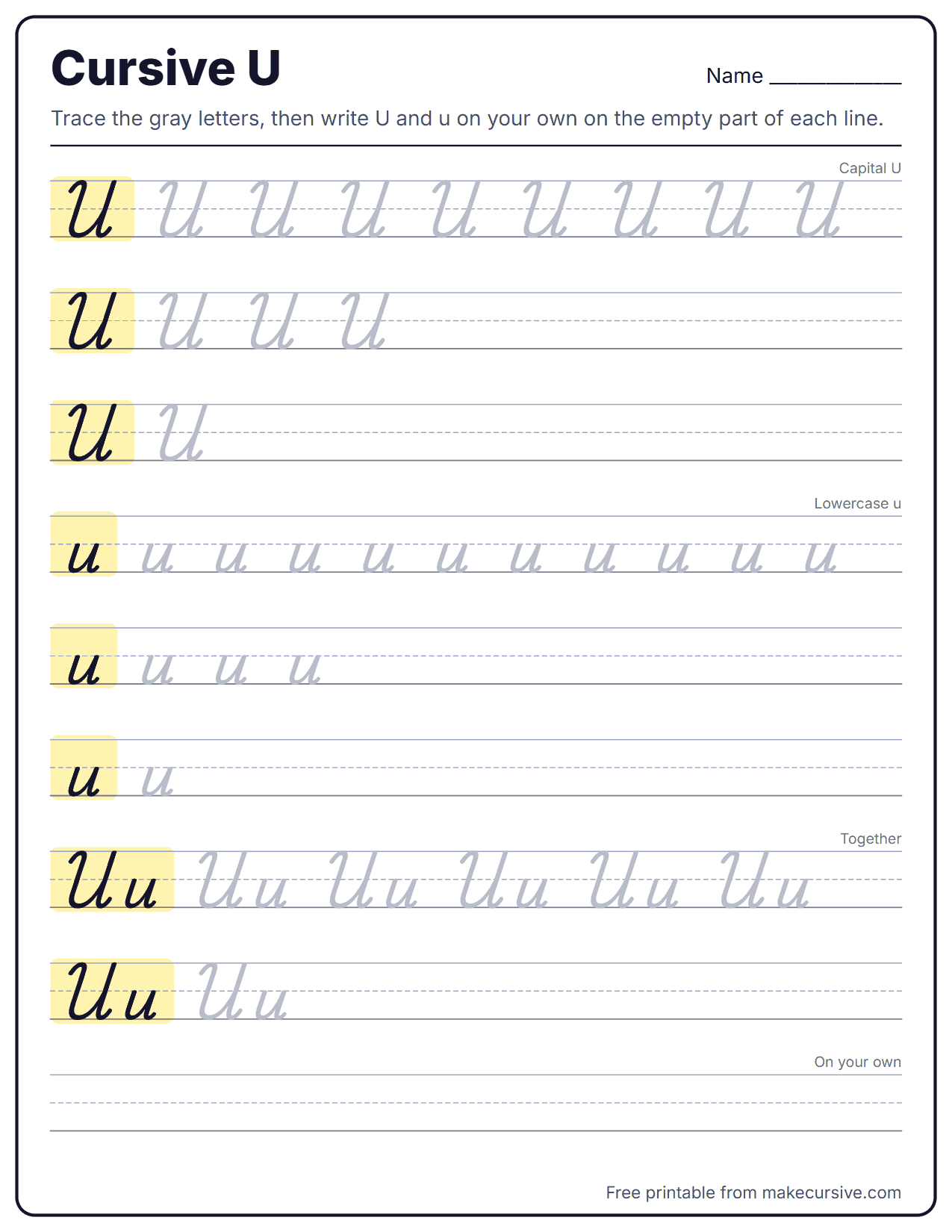
Uppercase, lowercase, and pair examples
Compare the capital U, lowercase u, and the Uu pair before you print or export practice text.
Capital U in cursive
Cursive capital U is a wide, open cup that begins with a small hook at the top left. Both sides reach the full capital height, and unlike T it usually joins straight into the next letter.
Capital U stroke steps
- Start a little below the top line with a small curve forward, like the handle of a cane.
- Slant down to the baseline.
- Round the bottom and undercurve back up to the top line on the right.
- Retrace straight down that right side to the baseline.
- Finish with an undercurve into the next letter.
Capital U vs Y (and V)
U and Y are identical until the second downstroke. U stops at the baseline; Y drops below it and closes a loop in the descender space. V often begins with the same hook too, but comes to a point at the bottom and ends with a bridge at the top instead of a retrace.
Common capital U mistakes
- A pointed bottom, which reads as V.
- A right side shorter than the left.
- A second downstroke that slips below the line, which makes Y.
- A gap instead of a retrace, which suggests W.
Lowercase u in cursive
Lowercase u belongs to the undercurve family and stays in the x-height zone. It is simply two undercurve-and-slant strokes in a row, with sharp tops at the midline and rounded bottoms on the baseline.
Lowercase u stroke steps
- Undercurve from the baseline to a point at the midline.
- Slant down to the baseline.
- Undercurve up to a second point at the same height.
- Slant back down to the baseline.
- Undercurve out.
u vs n, w, and ii
n has rounded humps on top and opens downward; u is the reverse. w adds a third point and ends with a bridge at the midline. A pair of undotted i's looks just like u, so the dots carry the meaning. v has one point and a bridge.
Common lowercase u mistakes
- Rounding the points into humps, so u reads as n.
- Points at different heights.
- Wide spacing, so u looks like two letters.
- A flick at the end that suggests w.
Joining u to other letters
u enters and exits on the baseline, so the joins themselves are simple. The risk is that u gets lost among neighbors with similar points or humps.
- ou (out, you, house): o ends high, so its bridge leads straight into the first u downstroke. Add exactly one more point; an extra one gives ouu, a rounded one gives on.
- un, nu (under, number): humps and cups side by side. Exaggerate the difference until it is automatic.
- ui, iu (fruit, build): three points in a row; the single dot must sit over the correct one.
- uu (vacuum): four equal points. Even spacing is the only thing that keeps them readable.
- bu (bus, but): b exits with a bridge, so u loses its first undercurve and starts from the midline.
A4 cursive alphabet practice sheet
Look over the full alphabet on this A4 preview, then print a sheet that contrasts U with Y and lowercase u with n and w.
Trace capital U
Alternate rows of U and Y so the stop feels different from the drop.
Trace lowercase u
Write a row of u, then a row of n, and compare tops.
Uu pairs
Check that the capital cup is wide and the lowercase is compact.
Vowel words
Finish with out, you, and house.
Cursive Alphabet Practice
Practice plan for U
u is a short vowel inside many common words, so most of the work is about contrast with its neighbors.
- Contrast. In focus practice, write U and Y on alternating rows, then lowercase u and n the same way.
- Neighbors. Make a worksheet with ou, un, nu, ui, and bu. Circle any u that could be read as another letter.
- Sentence. Write "Uma found us under the blue umbrella." and check that every u point is sharp.
Practice words for U
Each word places u next to a different kind of neighbor.
Cover the remaining letters with the cursive alphabet worksheets.
Cursive U questions
Why do cursive capital U and Y start the same way?
In American school cursive both letters open with the same small hook, the same first downstroke, and the same climb back to the top line. They split only on the second downstroke: U stops at the baseline and exits, while Y continues below the line into a loop. Watching where that stroke ends is the quickest way to tell them apart.
How do I keep cursive u from looking like n?
Think of direction. u is rounded at the bottom and pointed at the top, so it opens upward like a cup. n is rounded at the top and opens downward. If your u points have softened into humps, sharpen them and slow down at the midline.
What is the difference between cursive u and w?
w has three upstrokes instead of two and finishes with a short bridge at the midline before the next letter. u ends with a plain undercurve from the baseline. A u with an extra flick at the end can be misread as w.
How can I tell u from ii in cursive?
On their own they are almost identical, because u is two undercurve strokes and so is a pair of i's. The dots are the only real difference, which is why ii should always be dotted and u never should.
How other handwriting models draw U
Some programs start capital U without the hook, and some decorative styles round the lowercase points, which makes the u and n contrast above harder to see.