Left-handed mechanics
Left-Handed Cursive Writing: Paper Angle, Grip, and Smudge Fixes
Classroom workbooks assume a right hand pulling letters across dry paper. Left-handed writers push strokes into the ink they just laid down—which turns flat sheets into smudged, cramped pages unless you change paper angle, wrist placement, and pen drag first.
Three setup rules before writing a single loop
Most left-handed frustration stems from mechanics rather than coordination. Before drilling single letters, reset these three physical defaults:
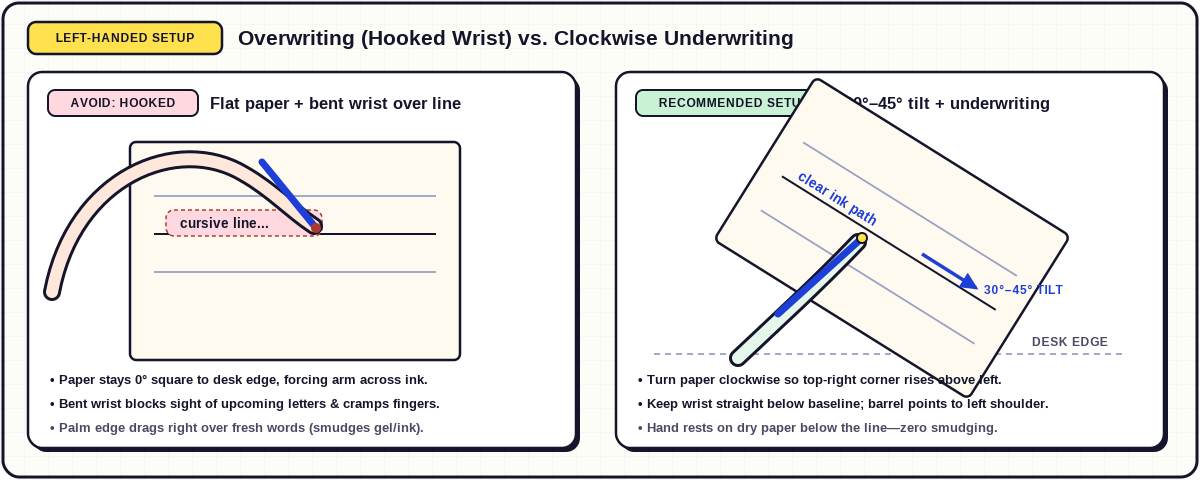
- Tilt the paper clockwise 30°–45°: Lower the top-left corner and lift the top-right corner so your writing baseline slopes upward across the desk, mirroring your forearm pivot.
- Drop your wrist below the baseline (underwriting): Keep a flat, relaxed wrist resting on clean paper below your words instead of hooking over the top into wet ink.
- Stop chasing a heavy forward slant: Upright letters (0°–5°) or a slight natural backslant read cleanly and stop wrist cramps.
Clockwise paper tilt and underwriting grip step by step
When a left-handed child or adult writes on a square, unrotated notebook page, the pinky edge of the hand sweeps straight over fresh ink while fingers block the view of the letter just written. Many learners reflexively curl their hand upward into an overwriting hook just to see the tip. That hook works for quick print notes, yet it locks shoulder travel during connected writing.
- Shift the sheet left of center: Slide the notebook three to five inches left of your chest midline so your elbow does not tuck against your ribs.
- Rotate 30°–45° clockwise: Turn the paper until sliding your hand left-to-right naturally traces along the printed rule without bending your wrist sideways.
- Point the pen end toward your left shoulder: Hold the barrel slightly farther back—roughly one inch above the tip—using a soft tripod grip so you can see connectors ahead of the nib.
- Nudge the page left, not your wrist right: After three or four words, slide the sheet slightly left with your right hand rather than stretching fingers off axis.
The truth about slant: upright, slight backslant, or forward tilt
Right-handed learners earn a natural forward lean automatically because pulling strokes toward the chest aligns with angled paper. For left-handers writing with an underwriting posture, pulling downstrokes toward the left hip often creates crisp upright stems—or even a gentle 5°–10° leftward tilt.
Do not twist your fingers to copy a 52-degree Palmer workbook slant unless you intentionally adopt steep clockwise paper rotation. Uniform height and steady parallel spacing determine whether words read smoothly; an upright model such as Learning Without Tears or New American in our handwriting style comparison matches natural left-handed geometry better than forced dramatic forward loops. Many teachers also note that left-handed cursive looks clearest when ascenders stay slightly shorter than the top margin line, leaving plenty of breathing room between descending tails on row one and tall loops on row two.
If a school strictly scores right-leaning penmanship, turn the sheet slightly farther clockwise—around 40 to 45 degrees—rather than bending your wrist. Pulling downstrokes straight toward your left elbow on a 45-degree sheet naturally shifts stems forward relative to the printed baseline without twisting your palm over wet ink.
Smudge-free pens tested for left-handed push strokes
Because left-handers push the ball or nib forward into paper fibers, overly scratchy extra-fine tips snag paper while wet liquid inks blot before drying. Matching tip smoothness and drying time solves half of the mess immediately.
| Pen type | Dry time | Push-stroke glide | Smudge risk | Practical takeaway |
|---|---|---|---|---|
| 0.5mm quick-dry gel pen | Fast (~1–2 seconds) | Very smooth; minimal paper drag | Low | Top everyday pick for notebooks and printable tracing sheets |
| Low-viscosity oil ballpoint | Near-instant | Smooth with medium tip (0.7mm–1.0mm); fine tips drag slightly | Very low | Safest option for glossy forms, envelopes, and hook-grip writers |
| Liquid ink rollerball | Slow (~4–8 seconds) | Effortless glide across fibers | High | Use only with strict underwriting below the line and absorbent paper |
| Fine fountain pen + fast-dry ink | Medium (~2–4 seconds) | Gentle with rounded nib; sharp extra-fine points catch on push strokes | Medium | Pair a smooth Western F or Japanese M nib with quick-dry ink and low-tilt posture |
| #2 / HB wooden or mechanical pencil | Instant (graphite deposit) | Slight tactile friction aids early stroke control | Medium (graphite rub) | Great for young kids on trace sheets; wipe palm lightly between rows |
Six left-handed join friction fixes on paper
Even with good posture and clean ink, specific mechanical snags show up repeatedly for left-handers. Match your symptom below to fix it on the next row.
| Left-handed friction point | Why it happens | Immediate fix |
|---|---|---|
| Pen tip catches paper on upstrokes | Pushing a sharp ball or nib steep-angled into soft paper grain | Hold barrel 1 inch from tip at ~45° to the desk and step up to a 0.5mm/0.7mm tip |
| Hooked wrist hides upcoming space | Wrist curls above line, covering words to the right of the nib | Rotate paper 35° clockwise and anchor pinky below the baseline |
| Spiral wire or binder rings dig into arm | Standard left-bound coils sit directly under the left palm | Print single loose sheets from the worksheet generator, use top-bound legal pads, or write on left-hand notebook backs |
| Crossbars on t, f, and x catch or smear | Pushing cross-strokes left-to-right against dry pen edge | Pull crossbars cleanly right-to-left after finishing the full word |
| Long bridges collapse after b, o, v, w | Fingers tighten during long sideways push across bridges | Lift and reset forearm position every 3–4 words; drill br, os, ve in large 54–62 px tracing rows |
| Thumb and index pads turn sore quickly | Over-pinching to stabilize push resistance across slick paper | Add a rubberized grip sleeve or use softer HB pencil lead on uncoated paper |
7-day left-handed reset drill (10 minutes daily)
Already writing with a bent hook wrist? Keep each session short—ten calm minutes prevents reverting to muscle tension—and print oversized sheets using our printable worksheet guide settings (Light trace, 54–60 px size, Top/Mid/Base guides).
- Days 1–2 (Tilt & slant drills): Print a blank page of tilted lines or type
l l l o o o u u u. Focus purely on gliding your forearm left-to-right with zero wrist hook. - Days 3–4 (Push-free upstrokes): Practice undercurves and ovals with
it tip at coat boatusing a smooth 0.5mm gel pen on dry matte paper. - Days 5–6 (Right-to-left crossbars & bridges): Type
brave little test waterin Connections/Word List mode, crossingtright-to-left only after ending each word. - Day 7 (Real two-line notes): Write a short postcard or shopping list on loose paper rotated 35° clockwise, then inspect spacing against our main stroke technique guide.
Whenever a hook habit sneaks back mid-week, pause for twenty seconds, place a blank guard sheet or blotter strip under your pinky side, and reset the paper angle before finishing the row. Keeping a loose clipboard tilted clockwise also stops sheets from sliding slowly back to zero degrees as you move down the page. For mixed kids/adult pacing beyond day seven, continue into our 14-day practice schedule.
FAQ: left-handed handwriting tips
Which direction should left-handed writers tilt their paper?
Tilt the paper clockwise 30 to 45 degrees so the top-right corner sits higher than the top-left corner, and shift the entire sheet slightly left of your body center. This keeps your forearm in a natural arc below the line you are writing.
Do left-handed writers have to force a forward right slant?
No. A consistent vertical (0-degree) or mild backslant (5 to 10 degrees left) is completely legible and puts far less strain on the left wrist. Consistency across every word matters far more than matching a right-handed workbook slant.
What pen smudges least for left-handed cursive?
A 0.5mm quick-drying gel pen or a smooth oil-based ballpoint produces the fewest smears on coated notebook paper. Avoid wet 0.7mm rollerballs and slow-drying fountain pen inks unless you use an underwriting wrist position below the baseline.
Why does my left hand ache after half a page of connected writing?
Left-handed writers push the pen tip rather than pulling it, which often triggers a tight death-grip when using high-friction pens or flat paper. Lightening your pinch, tilting the sheet clockwise, and switching to a smoother low-viscosity gel tip removes most hand tension.
Should left-handers cross t and f from right to left?
Yes, if pulling left feels smoother and avoids catching the pen tip in paper fibers. Either direction works cleanly because crossbars and dots are added after completing the joined word.